2013 · GS Paper 2 · Q25 · 10 marks
The World Bank and the IMF, collectively known as the Bretton Woods Institutions, are the two inter-governmental pillars supporting the structure of the world's economic and financial order. Superficially, the World Bank and the IMF exhibit many common characteristics, yet their role, functions and mandate are distinctly different. Elucidate.
In short
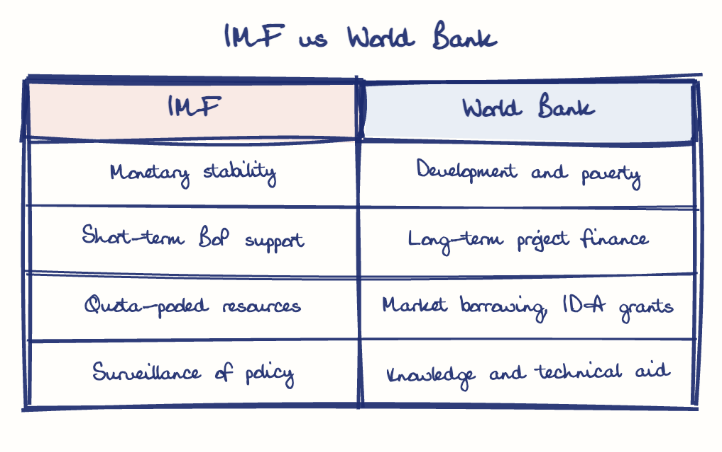
The IMF and the World Bank share a 1944 Bretton Woods origin, linked membership and weighted voting, but the IMF guards monetary stability through short-term balance-of-payments support while the Bank finances long-term development. India's 1991 IMF stand-by arrangement and the Bank's Eastern Dedicated Freight Corridor loans show the difference.
Model answer
Ghissu Editorial · Verified 4 Oct 2026 · 293 words
Shared origin and seat
Both came from the same 1944 conference, sit in Washington DC and meet jointly at Annual and Spring Meetings.
Linked membership
A country must join the IMF before the IBRD, so their memberships are almost identical.
Weighted voting
Votes follow quotas and capital shares, giving the United States an effective veto over 85 per cent decisions in both, while an unwritten convention gives the Bank an American head and the IMF a European one.
IMF as firefighter
The Fund rescues members short of reserves, as with India's stand-by arrangement in 1991 and Sri Lanka's Extended Fund Facility in March 2023.
Surveillance role
Annual Article IV consultations let the IMF monitor exchange rates and fiscal health, a task the Bank does not perform.
Bank as builder
The World Bank funds sectors over decades, such as India's Eastern Dedicated Freight Corridor, and its IDA arm lends almost free to the poorest nations.
This model answer is indicative and the model can make mistakes; please verify key facts independently.
Practise this question
1Get the answer sheet
Sized for this question.
2Write your answer
Timed, by hand.
3Get it marked
Your score and what to fix.
This chapter in the exam
Institutions12 questions
Asked in 10 of 14 sittings since 2013
- 2025"The reform process in the United Nations remains unresolved, because of the delicate imbalance of East and West and entanglement of the USA vs. Russo-Chinese alliance." Examine and critically evaluate the East-West policy confrontations in this regard.
- 2024Terrorism has become a significant threat to global peace and security.' Evaluate the effectiveness of the United Nations Security Council's Counter Terrorism Committee (CTC) and its associated bodies in addressing and mitigating this threat at the international level.
All 12 questions, sorted by sub-topic, with model answers and practice.
Question from the official UPSC Civil Services (Main) Examination 2013 paper. Answer written by Ghissu's engine and checked against our editorial standards. Found an error? Tell us and we correct it within 48 hours.