2013 · GS Paper 2 · Q24 · 10 marks
What is meant by Gujral doctrine ? Does it have any relevance today ? Discuss.
In short
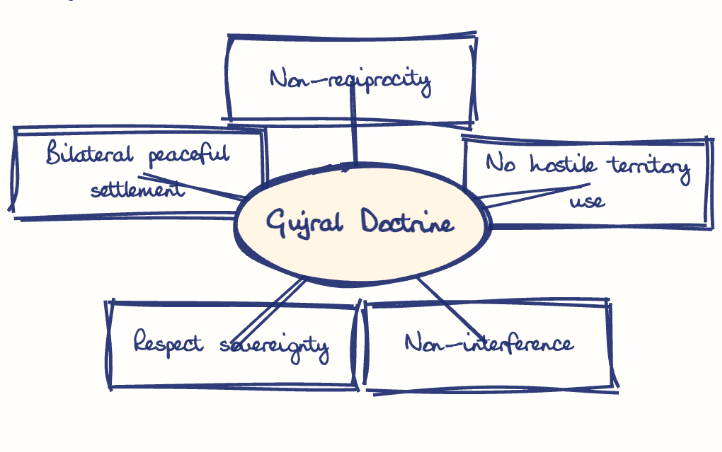
The Gujral Doctrine (1996-98) asked India to give smaller neighbours more than it demanded, while all South Asian states shunned interference and hostile use of territory. It still guides Neighbourhood First, as the 2015 Land Boundary Agreement shows, but Pakistan-based terror and China's rise demand firm deterrence alongside generosity.
Model answer
Ghissu Editorial · Verified 4 Oct 2026 · 268 words
Asymmetric generosity
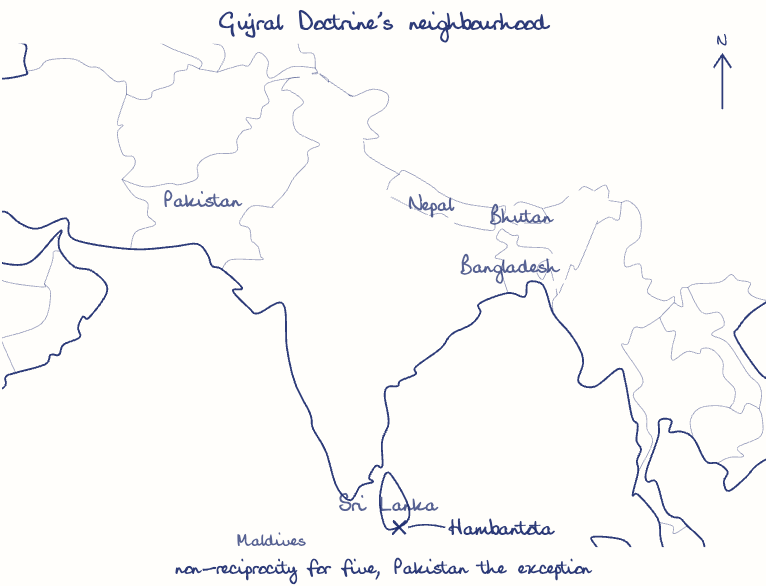
With Nepal, Bangladesh, Bhutan, Maldives and Sri Lanka, India would give and accommodate in good faith without demanding reciprocity.
Shared rules
All South Asian states would deny their territory to hostile acts, avoid interference, respect sovereignty and settle disputes through peaceful bilateral talks.
Purpose
It aimed to shed the "big brother" image after the IPKF years, so that a calm neighbourhood would free India for growth and a global role.
Neighbourhood First
The 2014 policy carries its spirit, seen in the Land Boundary Agreement with Bangladesh (100th Amendment, 2015) and about US$4 billion of support to Sri Lanka in its 2022 crisis.
Live test
The Ganga Waters Treaty falls due for renewal in 2026.
Limits with Pakistan
Terror from Pathankot (2016) to Pahalgam (2025) breaches the principle against hostile use of territory, prompting the Indus Waters Treaty's abeyance and Operation Sindoor.
The China factor
Hambantota's 99-year lease to China (2017) shows generosity without security assurances can be outbid.
This model answer is indicative and the model can make mistakes; please verify key facts independently.
Practise this question
1Get the answer sheet
Sized for this question.
2Write your answer
Timed, by hand.
3Get it marked
Your score and what to fix.
This chapter in the exam
Neighbourhood Relations13 questions
Asked in 7 of 14 sittings since 2013
- 2026“China’s Belt and Road Initiative (BRI) has transformed South Asia from a regional space into a theatre of great power competition.” Analyse the strategic implications of the BRI for India’s security and regional influence in South Asia.
- 2024Discuss the geopolitical and geostrategic importance of Maldives for India with a focus on global trade and energy flows. Further also discuss how this relationship affects India's maritime security and regional stability amidst international competition ?
All 13 questions, sorted by sub-topic, with model answers and practice.
Question from the official UPSC Civil Services (Main) Examination 2013 paper. Answer written by Ghissu's engine and checked against our editorial standards. Found an error? Tell us and we correct it within 48 hours.