2013 · GS Paper 3 · Q13 · 10 marks
Bringing out the circumstances in 2005 which forced amendment to the section 3(d) in Indian Patent Law, 1970, discuss how it has been utilized by the Supreme Court in its judgement in rejecting Novratis' patent application for 'Glivec'. Discuss briefly the pros and cons of the decision.
In short
Section 3(d) was tightened in 2005, when TRIPS forced product patents on medicines, to stop evergreening, and the Supreme Court used it to reject Novartis's Glivec patent. It held that beta-crystalline imatinib was a new form of a known drug without enhanced therapeutic efficacy.
Model answer
Ghissu Editorial · Verified 4 Oct 2026 · 284 words
TRIPS deadline
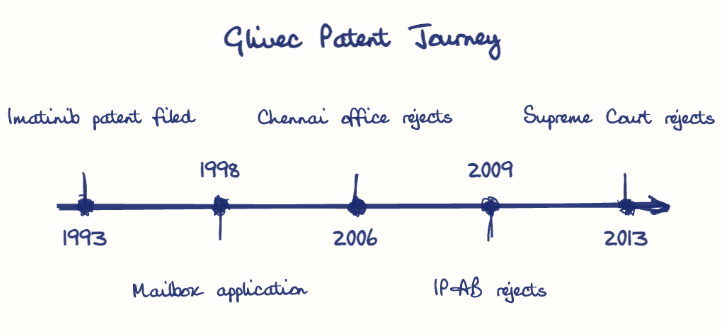
The transition ended on 1 January 2005, so the Patents (Amendment) Act, 2005 brought in drug product patents and opened the mailbox applications.
Evergreening and Doha
To stop monopolies on trivial variants such as salts or crystal forms, and using the Doha Declaration (2001), Parliament denied patents to new forms of known substances unless they enhance "known efficacy".
Known substance
In Novartis AG v Union of India (2013), the Court held beta-crystalline imatinib mesylate a mere new form of imatinib, disclosed earlier.
Therapeutic efficacy
For a medicine, efficacy meant therapeutic efficacy, and the claimed 30% higher bioavailability was not shown to improve treatment, so the claim failed.
Pros
Generic imatinib stayed at a fraction of Glivec's reported Rs 1.2 lakh a month, and the ruling showed that TRIPS flexibilities can be used lawfully.
Cons
Critics, including US Special 301 reviews, said it deters incremental innovation, and the undefined efficacy test breeds uncertainty.
This model answer is indicative and the model can make mistakes; please verify key facts independently.
Practise this question
1Get the answer sheet
Sized for this question.
2Write your answer
Timed, by hand.
3Get it marked
Your score and what to fix.
This chapter in the exam
Intellectual Property Rights5 questions
Asked in 5 of 14 sittings since 2013
- 2024What is the present world scenario of intellectual property rights with respect to life materials? Although, India is second in the world to file patents, still only a few have been commercialized. Explain the reasons behind this less commercialization.
- 2019How is the Government of India protecting traditional knowledge of medicine from patenting by pharmaceutical companies?
All 5 questions, sorted by sub-topic, with model answers and practice.
Question from the official UPSC Civil Services (Main) Examination 2013 paper. Answer written by Ghissu's engine and checked against our editorial standards. Found an error? Tell us and we correct it within 48 hours.