2024 · GS Paper 3 · Q5 · 10 marks
What is the present world scenario of intellectual property rights with respect to life materials? Although, India is second in the world to file patents, still only a few have been commercialized. Explain the reasons behind this less commercialization.
In short
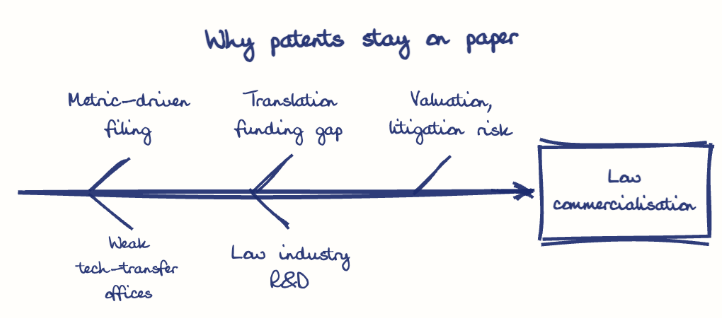
Globally, TRIPS lets countries exclude plants and animals but not micro-organisms from patents, while the 2024 WIPO treaty now requires disclosure of the origin of genetic resources. India's patents rarely reach the market because of metric-driven filing, weak technology transfer and scarce translation funding.
Model answer
Ghissu Editorial · Verified 4 Oct 2026 · 283 words
TRIPS baseline
Article 27.3(b) lets countries exclude plants and animals, but not micro-organisms, from patents; India does so in Section 3(j) and protects plant varieties through the PPV&FR Act 2001.
Liberal West
Diamond v. Chakrabarty (1980) opened US patents on engineered organisms, though Myriad Genetics (2013) held natural isolated DNA unpatentable.
Benefit-sharing
The Nagoya Protocol (in force 2014) demands consent and benefit-sharing, now linked to patent filings by the 2024 WIPO treaty.
Gene-editing frontier
The CRISPR-Cas9 dispute between the Broad Institute and the University of California shows life-editing tools are fiercely contested.
Filing for metrics
Academic patents are often filed for NIRF rankings or promotions, not for a market need.
Weak industry linkage
Few universities have professional technology transfer offices, and private industry funds only about 45% of R&D.
Valley of death
Little money supports prototypes and scale-up, a gap that ANRF (2023) and the Rs 1 lakh crore RDI Fund (2025) aim to close.
Market and legal risk
Uncertain valuation, costly enforcement and lapsed renewals leave inventions dormant.
This model answer is indicative and the model can make mistakes; please verify key facts independently.
Practise this question
1Get the answer sheet
Sized for this question.
2Write your answer
Timed, by hand.
3Get it marked
Your score and what to fix.
This chapter in the exam
Intellectual Property Rights5 questions
Asked in 5 of 14 sittings since 2013
- 2019How is the Government of India protecting traditional knowledge of medicine from patenting by pharmaceutical companies?
- 2015India's Traditional Knowledge Digital Library (TKDL), which has a database containing formatted information on more than 2 million medicinal formulations is proving a powerful weapon in the country's fight against erroneous patents. Discuss the pros and cons of making this database publicly available under open-source licensing.
All 5 questions, sorted by sub-topic, with model answers and practice.
Question from the official UPSC Civil Services (Main) Examination 2024 paper. Answer written by Ghissu's engine and checked against our editorial standards. Found an error? Tell us and we correct it within 48 hours.