2013 · GS Paper 3 · Q8 · 10 marks
Establish relationship between land reforms, agriculture productivity and elimination of poverty in the Indian economy. Discuss the difficulties in designing and implementation of agriculture-friendly land reforms in India.
In short
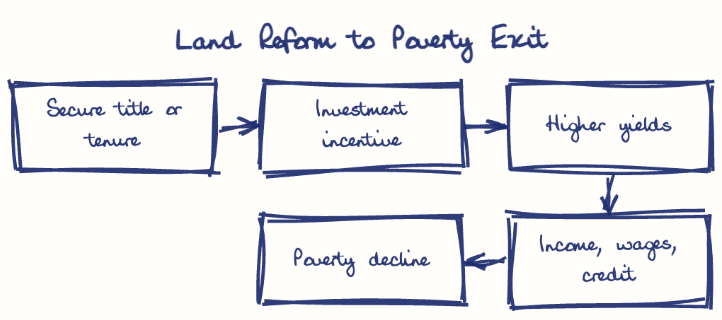
Land reforms raise productivity and cut poverty by giving cultivators secure tenure, credit and an incentive to invest, but ceiling evasion, concealed tenancy, poor records and fragmentation hamper agriculture-friendly design. Operation Barga's registration of West Bengal's sharecroppers measurably lifted farm productivity.
Model answer
Ghissu Editorial · Verified 4 Oct 2026 · 274 words
Tenure security
Operation Barga (1978) recorded over a million sharecroppers in West Bengal, and Banerjee, Gertler and Ghatak (2002) traced over a quarter of the state's later productivity growth to it.
Small farms, high output
The inverse farm-size relationship (Amartya Sen) means redistributed land on family-labour farms is farmed more intensively, aligning equity with efficiency.
Land against poverty
Besley and Burgess (2000) found that states with more tenancy reform cut rural poverty faster, as land gives collateral and wage bargaining power.
Equity versus efficiency
Tenancy bans drove leasing underground; NITI Aayog's Model Land Leasing Act (2016) seeks to legalise it.
Landed political power
Benami transfers hollowed out ceilings, and courts struck down early laws until the First Amendment (1951) created the Ninth Schedule.
Weak records
Unrecorded tenants and presumptive titles persist despite record computerisation under DILRMP, as cadastral resurveys lag.
Fragmentation and diversity
Land is a State subject, and the average holding has shrunk to 1.08 hectares (Agriculture Census 2015-16).
This model answer is indicative and the model can make mistakes; please verify key facts independently.
Practise this question
1Get the answer sheet
Sized for this question.
2Write your answer
Timed, by hand.
3Get it marked
Your score and what to fix.
This chapter in the exam
Land Reforms in India7 questions
Asked in 7 of 14 sittings since 2013
- 2024What were the factors responsible for the successful implementation of land reforms in some parts of the country? Elaborate.
- 2023State the objectives and measures of land reforms in India. Discuss how land ceiling policy on landholding can be considered as an effective reform under economic criteria.
All 7 questions, sorted by sub-topic, with model answers and practice.
Question from the official UPSC Civil Services (Main) Examination 2013 paper. Answer written by Ghissu's engine and checked against our editorial standards. Found an error? Tell us and we correct it within 48 hours.