2024 · GS Paper 3 · Q3 · 10 marks
What were the factors responsible for the successful implementation of land reforms in some parts of the country? Elaborate.
In short
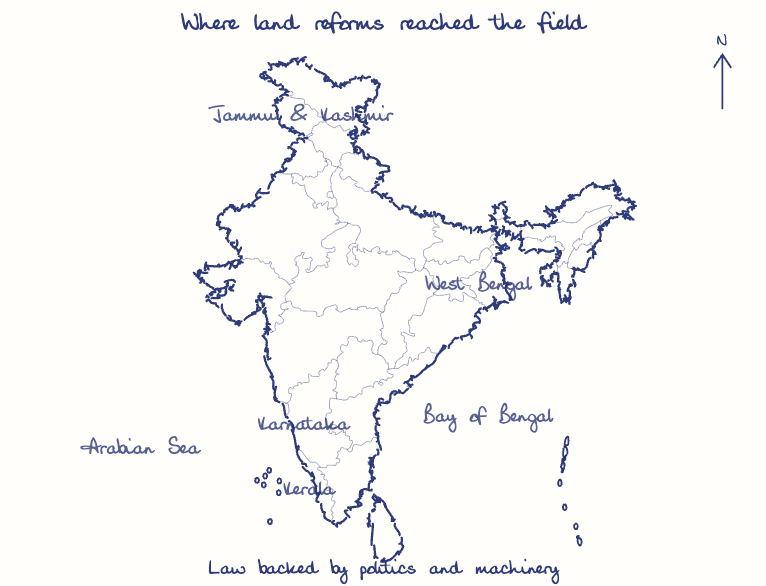
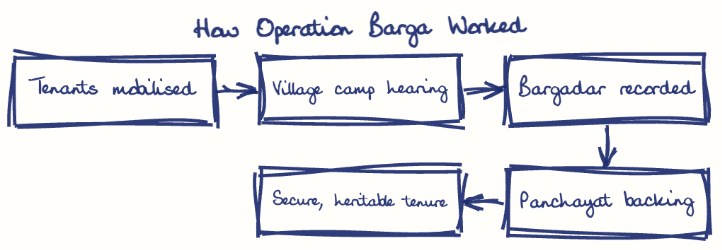
Land reforms succeeded where political will, organised tenants and field-level administration came together, as in Jammu and Kashmir, Kerala, Karnataka and West Bengal. West Bengal's Operation Barga recorded over a million sharecroppers through village camps, turning paper rights into enforceable tenure.
Model answer
Ghissu Editorial · Verified 4 Oct 2026 · 269 words
Political will
Jammu and Kashmir's 1950 Act gave surplus land to tillers without compensation, Kerala enforced its 1969 Act from 1970, and West Bengal's Left Front made tenancy reform its first agenda after 1977.
Peasant mobilisation
The Tebhaga movement (1946-47) and the Kerala Karshaka Sangham created organised tenants who pressed for enforcement.
Social awakening
Kerala's reform movements and high literacy made tenants aware of their rights, while Devaraj Urs in Karnataka built a tenant and backward-class coalition against the landed lobby.
Records at the doorstep
Operation Barga's village camps, held with sharecroppers present, registered over a million bargadars whose rights had existed only on paper.
Shifted burden of proof
West Bengal's amended law presumed a cultivator to be a sharecropper unless the owner proved otherwise, defeating the landlord's usual denial.
Fast adjudication and legal shield
Karnataka's 1974 land tribunals decided claims locally, and the Ninth Schedule (1951) protected reform laws from litigation.
This model answer is indicative and the model can make mistakes; please verify key facts independently.
Practise this question
1Get the answer sheet
Sized for this question.
2Write your answer
Timed, by hand.
3Get it marked
Your score and what to fix.
This chapter in the exam
Land Reforms in India7 questions
Asked in 7 of 14 sittings since 2013
- 2023State the objectives and measures of land reforms in India. Discuss how land ceiling policy on landholding can be considered as an effective reform under economic criteria.
- 2021How did land reforms in some parts of the country help to improve the socio-economic conditions of marginal and small farmers ?
All 7 questions, sorted by sub-topic, with model answers and practice.
Question from the official UPSC Civil Services (Main) Examination 2024 paper. Answer written by Ghissu's engine and checked against our editorial standards. Found an error? Tell us and we correct it within 48 hours.