2013 · GS Paper 3 · Q7 · 10 marks
Examine the impact of liberalization on companies owned by Indians. Are they competing with the MNCs satisfactorily ? Discuss.
In short
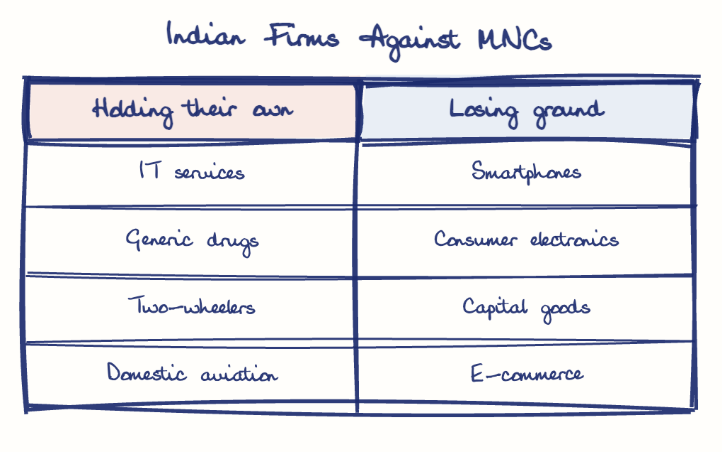
Liberalisation since 1991 forced Indian firms to compete or exit, and they now match MNCs in IT services, generic drugs, two-wheelers and aviation but trail them in electronics, smartphones and capital goods. India's R&D spending below 1% of GDP is the main reason for the gap.
Model answer
Ghissu Editorial · Verified 4 Oct 2026 · 310 words
Shock of competition
Protected firms had to cut costs or exit, as the Ambassador lost the car market to Maruti Suzuki and Hyundai and stopped production in 2014.
Takeover of brands
Parle sold Thums Up to Coca-Cola in 1993, and Flipkart went to Walmart in 2018 for about $16 billion.
Global reach
Access to capital and technology let Indian groups buy abroad, as Tata Steel bought Corus (2007) and Tata Motors bought Jaguar Land Rover (2008).
Where they win
TCS and Infosys compete with Accenture and IBM, Sun Pharma and Dr Reddy's lead in generic medicines, and Indian-owned IndiGo carries over 60% of domestic air passengers.
Where MNCs dominate
Samsung and Chinese brands such as Xiaomi hold electronics and smartphones, Micromax collapsed after 2015, and BHEL lost orders to Chinese power equipment.
Why the gap persists
Gross R&D spending below 1% of GDP, costly capital and small firm size keep many Indian companies assembling rather than designing.
This model answer is indicative and the model can make mistakes; please verify key facts independently.
Practise this question
1Get the answer sheet
Sized for this question.
2Write your answer
Timed, by hand.
3Get it marked
Your score and what to fix.
This chapter in the exam
Liberalization9 questions
Asked in 6 of 14 sittings since 2013
- 2025What are the challenges before the Indian economy when the world is moving away from free trade and multilateralism to protectionism and bilateralism ? How can these challenges be met ?
- 2018How would the recent phenomena of protectionism and currency manipulations in world trade affect macroeconomic stability of India?
All 9 questions, sorted by sub-topic, with model answers and practice.
Question from the official UPSC Civil Services (Main) Examination 2013 paper. Answer written by Ghissu's engine and checked against our editorial standards. Found an error? Tell us and we correct it within 48 hours.