2013 · GS Paper 3 · Q21 · 10 marks
Money laundering poses a serious security threat to a country's economic sovereignty. What is its significance for India and what steps are required to be taken to control this menace?
In short
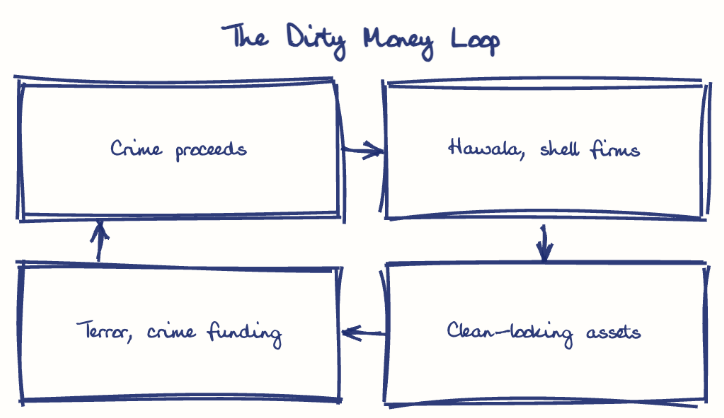
Money laundering threatens India's economic sovereignty by funding terrorism, disguising black money as foreign investment and eroding the tax base. Controlling it needs the PMLA's tightened powers, beneficial-ownership transparency, data-driven detection by FIU-IND and cooperation through FATF and tax-information exchange.
Model answer
Ghissu Editorial · Verified 4 Oct 2026 · 267 words
Terror financing
Hawala funds sustain cross-border terrorism, as the NIA's 2017 Jammu and Kashmir terror-funding case, which traced money from Pakistan to separatists, showed.
Economic sovereignty
Round-tripping disguises black money as foreign investment; Mauritius topped FDI inflows until the 2016 treaty protocol curbed it.
Tax and institutions
Laundered wealth in property, gold and offshore accounts escapes tax, while shell firms mask frauds such as the Nirav Modi case (2018) and fund corruption.
Legal tightening
The 2019 PMLA amendments, upheld in Vijay Madanlal Choudhary (2022), with the Benami Act 2016 and Fugitive Economic Offenders Act 2018, close escape routes.
Ownership transparency
Significant Beneficial Owners rules (2018) and the removal of over two lakh shell companies in 2017 should lead to a verified ownership registry.
Data-driven detection
FIU-IND's FINnet, Project Insight and GST analytics can flag mismatches between income, spending and invoices.
Global cooperation
FATF standards, the Egmont Group, automatic exchange of financial information and revised tax treaties help trace assets abroad.
This model answer is indicative and the model can make mistakes; please verify key facts independently.
Practise this question
1Get the answer sheet
Sized for this question.
2Write your answer
Timed, by hand.
3Get it marked
Your score and what to fix.
This chapter in the exam
Money-laundering3 questions
Asked in 3 of 14 sittings since 2013
- 2023Give out the major sources of terror funding in India and the efforts being made to curtail these sources. In the light of this, also discuss the aim and objective of the 'No Money for Terror (NMFT)' Conference recently held at New Delhi in November 2022.
- 2021Discuss how emerging technologies and globalisation contribute to money laundering. Elaborate measures to tackle the problem of money laundering both at national and international levels.
Question from the official UPSC Civil Services (Main) Examination 2013 paper. Answer written by Ghissu's engine and checked against our editorial standards. Found an error? Tell us and we correct it within 48 hours.