2021 · GS Paper 3 · Q9 · 10 marks
Discuss how emerging technologies and globalisation contribute to money laundering. Elaborate measures to tackle the problem of money laundering both at national and international levels.
In short
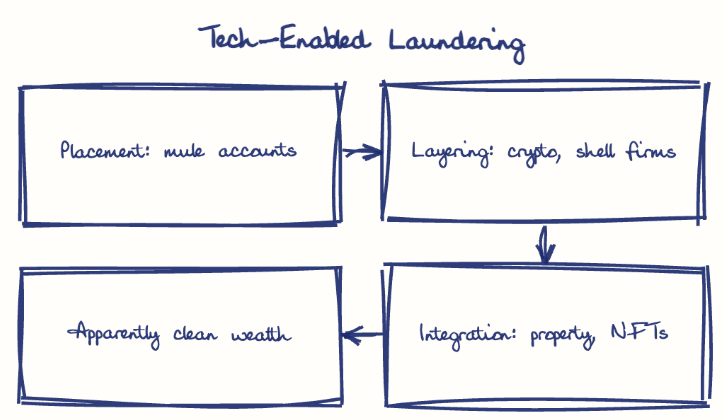
Emerging technologies such as crypto, instant payments and betting apps speed up laundering, while globalised trade and offshore shell firms make it borderless. India counters it through the PMLA 2002 and FIU-IND reporting, and globally through FATF standards, the Egmont Group and tax-information exchange.
Model answer
Ghissu Editorial · Verified 4 Oct 2026 · 283 words
Anonymous digital assets
Crypto wallets and mixers move value across borders in minutes, so India brought crypto service providers under the PMLA in March 2023.
Fintech and gaming rails
Instant payments and betting apps scatter cash across thousands of rented "mule" accounts.
Trade-based laundering
Over- and under-invoicing in global trade shifts value abroad; Global Financial Integrity (2021) put such gaps in 134 developing countries at $1.6 trillion in 2018.
Offshore secrecy
Shell firms in tax havens hide real owners, as the Panama (2016) and Pandora (2021) Papers showed.
National law
The PMLA 2002, upheld in Vijay Madanlal Choudhary (2022), the Black Money Act 2015 and the Fugitive Economic Offenders Act 2018 reach hidden assets and absconders.
Wider reporting
Crypto platforms and chartered accountants handling client funds now report suspicious transactions to FIU-IND.
Global standards
FATF's 40 Recommendations, including the virtual-asset "travel rule", set the benchmark, and FATF's 2024 review placed India in "regular follow-up".
Cooperation
The Vienna and Palermo Conventions, the Egmont Group and automatic tax-information exchange trace money across jurisdictions.
This model answer is indicative and the model can make mistakes; please verify key facts independently.
Practise this question
1Get the answer sheet
Sized for this question.
2Write your answer
Timed, by hand.
3Get it marked
Your score and what to fix.
This chapter in the exam
Money-laundering3 questions
Asked in 3 of 14 sittings since 2013
- 2023Give out the major sources of terror funding in India and the efforts being made to curtail these sources. In the light of this, also discuss the aim and objective of the 'No Money for Terror (NMFT)' Conference recently held at New Delhi in November 2022.
- 2013Money laundering poses a serious security threat to a country's economic sovereignty. What is its significance for India and what steps are required to be taken to control this menace?
Question from the official UPSC Civil Services (Main) Examination 2021 paper. Answer written by Ghissu's engine and checked against our editorial standards. Found an error? Tell us and we correct it within 48 hours.