2013 · GS Paper 3 · Q5 · 10 marks
What are the different types of agriculture subsidies given to farmers at the national and at state levels? Critically analyse the agricultural subsidy regime with reference to the distortions created by it.
In short
India's farm subsidies run from central fertiliser, MSP, credit and PM-KISAN support to state free power and loan waivers, and in their present form they distort input use, cropping patterns, equity and public spending. Only about 6% of farmers sell at MSP to procurement agencies, per the Shanta Kumar Committee (2015).
Model answer
Ghissu Editorial · Verified 4 Oct 2026 · 284 words
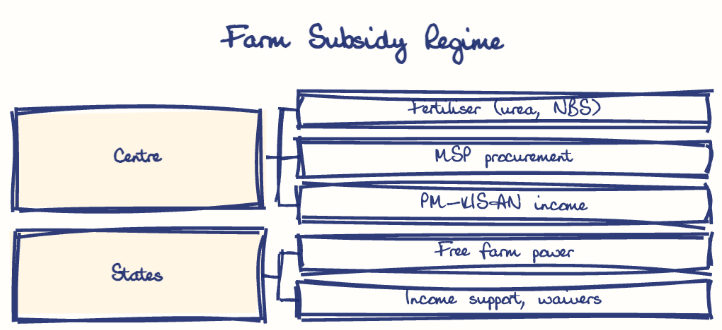
Central support
The Centre fixes urea prices, pays Nutrient Based Subsidy (2010) on P and K, procures at MSP, and funds interest subvention, PMFBY (2016) and PM-KISAN's ₹6,000 a year (2019).
State support
Free farm power in Punjab (since 1997) and Telangana, Rythu Bandhu (2018), KALIA and repeated loan waivers.
Skewed input use
Cheap urea against costlier P and K has pushed the NPK ratio far from the 4:2:1 norm, degrading soils, and urea leaks to industry and across borders.
Water and cropping pattern
Free power and assured paddy procurement lock Punjab into rice-wheat, leaving most blocks groundwater over-exploited (CGWB), while India imported 56% of its edible oil in 2023-24.
Inequity
The Shanta Kumar Committee (2015) found only about 6% of farmers sell at MSP to procurement agencies.
Fiscal and trade cost
Subsidies crowd out irrigation and research spending, and rice support reached 15.22% of output value in 2021-22 against the WTO's 10% limit.
This model answer is indicative and the model can make mistakes; please verify key facts independently.
Practise this question
1Get the answer sheet
Sized for this question.
2Write your answer
Timed, by hand.
3Get it marked
Your score and what to fix.
This chapter in the exam
Farm Subsidies and Minimum Support Prices8 questions
Asked in 8 of 14 sittings since 2013
- 2026Discuss the different types of subsidies and supports provided by the Government of India to agricultural sector. Examine the related issues pertaining to Agreement on Agriculture of World Trade Organisation (WTO). (Answer in 250 words)
- 2023What are the direct and indirect subsidies provided to farm sector in India? Discuss the issues raised by the World Trade Organization (WTO) in relation to agricultural subsidies.
All 8 questions, sorted by sub-topic, with model answers and practice.
Question from the official UPSC Civil Services (Main) Examination 2013 paper. Answer written by Ghissu's engine and checked against our editorial standards. Found an error? Tell us and we correct it within 48 hours.