2013 · GS Paper 3 · Q16(a) · 5 marks
What is a digital signature ? What does its authentication mean ? Give various salient built-in features of a digital signature.
In short
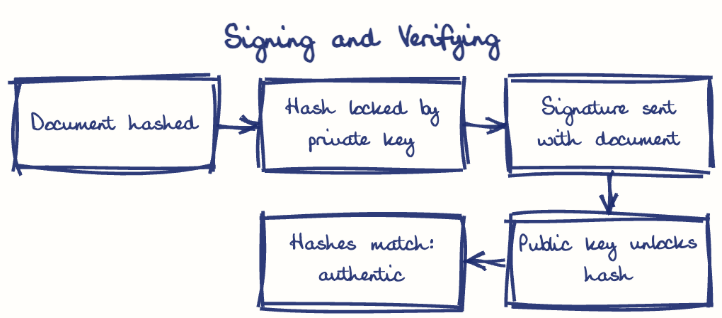
A digital signature is a code made with the signer's private key and a hash function, and authentication means confirming through the public key that a record came from the claimed signer unaltered. Its built-in features are integrity, non-repudiation, document-specificity, revocability and legal validity under the IT Act, 2000.
Model answer
Ghissu Editorial · Verified 4 Oct 2026 · 287 words
Meaning
It is a mathematical code created with the signer's private key under an asymmetric cryptosystem and a hash function, backed by a Digital Signature Certificate from a licensed Certifying Authority.
What authentication means
The recipient can confirm that the record came from the claimed signer and was not altered afterwards, since only the matching public key opens the signature.
Chain of trust
The Controller of Certifying Authorities under Section 17 of the IT Act licenses the Certifying Authorities, as in the Aadhaar-based eSign service of 2015.
Integrity
A change of a single character alters the hash, exposing tampering at once.
Non-repudiation
Only the signer holds the private key, so the signer cannot deny signing, and Section 5 of the IT Act gives it the legal standing of a handwritten signature.
Document-specific
Each signature is computed from one document and cannot be pasted onto another.
Validity and revocation
The certificate expires and can be revoked if the key is compromised, and a timestamp fixes the signing time.
Secure key storage
The private key sits on a PIN-protected cryptographic token.
This model answer is indicative and the model can make mistakes; please verify key facts independently.
Practise this question
1Get the answer sheet
Sized for this question.
2Write your answer
Timed, by hand.
3Get it marked
Your score and what to fix.
This chapter in the exam
IT5 questions
Asked in 5 of 14 sittings since 2013
- 2026What is agentic Artificial Intelligence (AI)? Explain its working. Describe its applications with suitable examples. Discuss the advantages, risks and challenges associated with agentic AI systems. (Answer in 250 words)
- 2024What is the technology being employed for electronic toll collection on highways? What are its advantages and limitations? What are the proposed changes that will make this process seamless? Would this transition carry any potential hazards?
All 5 questions, sorted by sub-topic, with model answers and practice.
Question from the official UPSC Civil Services (Main) Examination 2013 paper. Answer written by Ghissu's engine and checked against our editorial standards. Found an error? Tell us and we correct it within 48 hours.