2013 · GS Paper 4 · Q11 · 25 marks
Sivakasi in Tamil Nadu is known for its manufacturing clusters on firecrackers and matches. The local economy of the area is largely dependent on firecrackers industry. It has led to tangible economic development and improved standard of living in the area. So far as child labour norms for hazardous industries like firecrackers industry are concerned, International Labour Organization (ILO) has set the minimum age as 18 years. In India, however, this age is 14 years. The units in industrial clusters of firecrackers can be classified into registered and non-registered entities. One typical unit is household-based work. Though the law is clear on the use of child labour employment norms in registered/non-registered units, it does not include household-based works. Household-based work means children working under the supervision of their parents/relatives. To evade child labour norms, several units project themselves as household-based works but employ children from outside. Needless to say that employing children saves the costs for these units leading to higher profits to the owners. You have visited a unit in Sivakasi, where you notice about 10-15 children below 14 years of age. The owner tells you that in his household-based unit, the children are all his relatives. You notice that several children smirk, when the owner tells you this. On deeper enquiry, you figure out that neither the owner nor the children are able to satisfactorily establish their relationship with each other. (a) Bring out and discuss the ethical issues involved in the above case. (b) What would be your reaction after your above visit?
In short
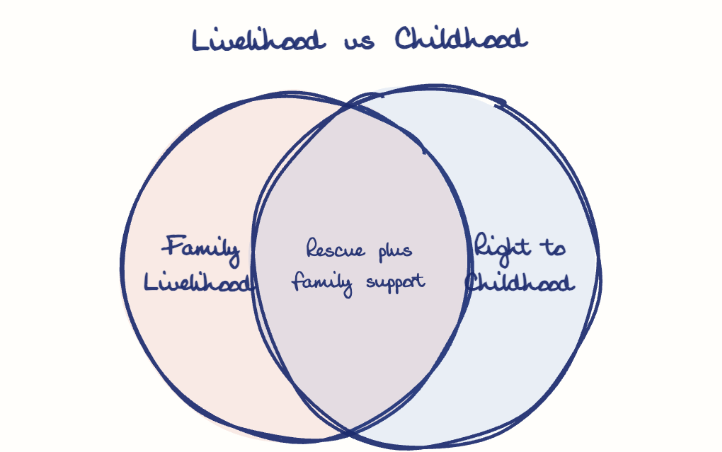
The case involves children used as cheap labour in a hazardous trade under cover of the household exemption, a clash between local livelihood and the right to childhood. I would rescue and rehabilitate the children, prosecute the owner and recover compensation as M.C. Mehta v State of Tamil Nadu (1996) directed.
Model answer
Ghissu Editorial · Verified 4 Oct 2026 · 266 words
The children's smirk exposed the "household" as a cover. The core dilemma is between the Livelihood of a prosperous cluster and the Right to Childhood under Articles 21A and 24.
(a) Ethical Issues Involved in the Case
1. Children as means: Child labour cuts costs by treating children as tools in a hazardous trade where the 2012 Mudalipatti blast near Sivakasi killed about 40. 2. Letter vs spirit: Abusing the household exemption is deceit dressed as compliance, a Yudhishthira's Half-Truth. 3. Double standard: The ILO's age bar for hazardous work is 18; Indian law then set 14. 4. Normalised exploitation and state failure: Coached children and lax inspection reflect Motivated Blindness and systemic Bystander Apathy.
Record and rescue
Document ages and statements, alert the labour officer, police and Childline 1098 [scheme], and produce the children before the Child Welfare Committee.
Prosecute
Invoke child labour law and Section 79 of the Juvenile Justice Act, 2015, and recover compensation per M.C. Mehta (1996) [case].
Rehabilitate
Enrol the children in bridge schooling under Samagra Shiksha, which has absorbed the NCLP [scheme], and link parents to livelihood support.
Close the loophole
Survey home units through the PENCIL portal (2017) [scheme] and require proof of kinship.
This model answer is indicative and the model can make mistakes; please verify key facts independently.
Practise this question
1Get the answer sheet
Sized for this question.
2Write your answer
Timed, by hand.
3Get it marked
Your score and what to fix.
This chapter in the exam
Regulatory and Quasi-Judicial Dilemmas4 questions
Asked in 4 of 14 sittings since 2013
- 2022You are appointed as an officer heading the section in Environment Pollution Control Board to ensure compliance and its follow-up. In that region, there were large number of small and medium industries which had been granted clearance. You learnt that these industries provide employment to many migrant workers. Most of the industrial units have got environmental clearance certificate in their possession. The environmental clearance seeks to curb industries and projects that supposedly hamper environment and living species in the region. But in practice, most of these units remain to be polluting units in several ways like air, water and soil pollution. As such, local people encountered persistent health problems. It was confirmed that majority of the industries were violating environmental compliance. You issued notice to all the industrial units to apply for fresh environmental clearance certificate from the competent authority. However, your action met with hostile response from a section of the industrial units, other vested interest persons and a section of the local politicians. The workers also became very hostile to you as they felt that your action would lead to the closure of these industrial units, and the resultant unemployment will lead to insecurity and uncertainty in their livelihood. Many owners of the industries approached you with the plea that you should not initiate harsh action as it would compel them to close their units, and cause huge financial loss, shortage of their products in the market. These would obviously add to the sufferings of the labourers and the consumers alike. The labour union also sent you representation requesting against the closure of the units. You simultaneously started receiving threats from unknown corners. You however received supports from some of your colleagues, who advised you to act freely to ensure environmental compliance. Local NGOs also came to your support and they demanded the closure of the polluting units immediately. (a) What are the options available to you under the given situation? (b) Critically examine the options listed by you. (c) What type of mechanism would you suggest to ensure environmental compliance? (d) What are the ethical dilemmas you faced in exercising your option?
- 2018Dr. X is a leading medical practitioner in a city. He has set up a charitable trust through which he plans to establish a super-specialty hospital in the city to cater to the medical needs of all sections of the society. Incidentally, that part of the State had been neglected over the years. The proposed hospital would be a boon for the region. You are heading the tax investigation agency of that region. During an inspection of the doctor's clinic, your office has found out some major irregularities. A few of them are substantial which had resulted in considerable withholding of tax that should be paid by him now. The doctor is cooperative. He undertakes to pay the tax immediately. However, there are certain other deficiencies in his tax compliance which are purely technical in nature. If these technical defaults are pursued by the agency, considerable time and energy of the doctor will be diverted to issues which are not so serious, urgent or even helpful to the tax collection process. Further, in all probability, it will hamper the prospects of the hospital coming up. There are two options before you: (i) Taking a broader view, ensure substantial tax compliance and ignore defaults that are merely technical in nature. (ii) Pursue the matter strictly and proceed on all fronts, whether substantial or merely technical. As the head of the tax agency, which course of action will you opt for and why?
All 4 questions, sorted by sub-topic, with model answers and practice.
Question from the official UPSC Civil Services (Main) Examination 2013 paper. Answer written by Ghissu's engine and checked against our editorial standards. Found an error? Tell us and we correct it within 48 hours.