2014 · GS Paper 1 · Q23 · 10 marks
Account for the change in the spatial pattern of the Iron and Steel industry in the world.
In short
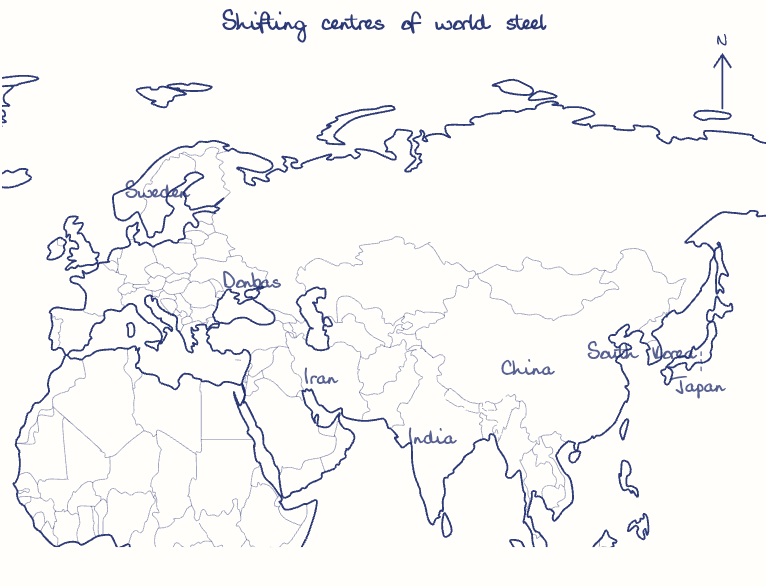
The world iron and steel industry has shifted from coalfields to coastal break-of-bulk sites, to market-based mini-mills and finally to Asia as technology, costs and markets changed. China now makes over half the world's crude steel, and India became the second largest producer in 2018.
Model answer
Ghissu Editorial · Verified 4 Oct 2026 · 290 words
Iron and steel is a weight-losing industry, so it locates where coal, ore and markets meet most cheaply. As that point moved, the industry shifted from Europe and North America to coasts and then to Asia, where China makes over half the world's crude steel.
Phases of the Changing Pattern
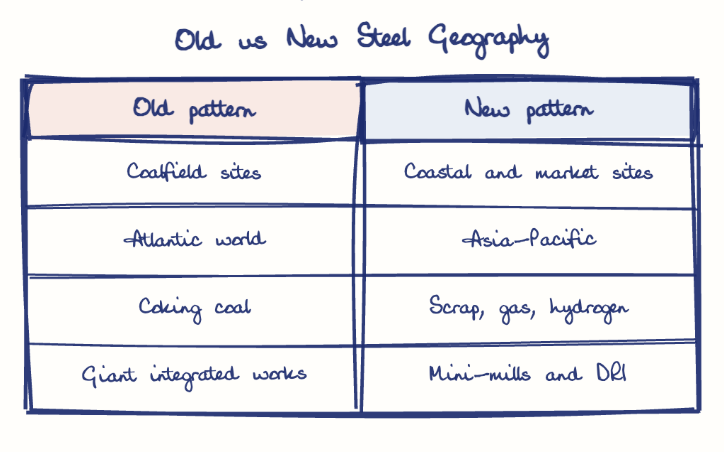
Old vs New Steel Geography a: Old pattern b: New pattern → Coalfield sites :: Coastal and market sites → Atlantic world :: Asia-Pacific → Coking coal :: Scrap, gas, hydrogen → Giant integrated works :: Mini-mills and DRI
Coalfield phase
When steel needed several tonnes of coal per tonne, plants clustered in the Ruhr, Pittsburgh, Sheffield and the Donbas.
Break-of-bulk coasts
Imported Pilbara and Carajas ore favoured port plants such as Chiba, Pohang (1973), IJmuiden and Taranto.
Mini-mills
Scrap-based electric arc furnaces, led by Nucor, let smaller plants locate near cities and their scrap supply.
Asian ascent
Cheap labour, state support and construction booms made China dominant, and India became second largest in 2018.
Technology
Lower coke rates and new furnaces weakened the coalfield pull, while gas-based direct reduction drew plants to the Gulf.
Costs and markets
High wages, ageing plants and saturated demand created the US Rust Belt and shrank European output as demand grew in Asia.
Environment and policy
The EU's Carbon Border Adjustment Mechanism is steering investment to hydrogen steel, as in Sweden's HYBRIT project, which delivered fossil-free steel in 2021.
This model answer is indicative and the model can make mistakes; please verify key facts independently.
Practise this question
1Get the answer sheet
Sized for this question.
2Write your answer
Timed, by hand.
3Get it marked
Your score and what to fix.
This chapter in the exam
International Trade / Transport and Activities12 questions
Asked in 9 of 14 sittings since 2013
- 2026"The centre of global trade is gradually shifting from the Atlantic region to the Indo-Pacific region." Examine this statement.
- 2022Mention the significance of straits and isthmus in international trade.
All 12 questions, sorted by sub-topic, with model answers and practice.
Question from the official UPSC Civil Services (Main) Examination 2014 paper. Answer written by Ghissu's engine and checked against our editorial standards. Found an error? Tell us and we correct it within 48 hours.