2026 · GS Paper 1 · Q16 · 15 marks
"The centre of global trade is gradually shifting from the Atlantic region to the Indo-Pacific region." Examine this statement.
In short
The statement is largely valid, as production, shipping and new trade blocs have moved global trade's centre towards the Indo-Pacific, though Atlantic finance and nearshoring keep that ocean vital. The US Indo-Pacific Strategy (2022) notes the region holds nearly two-thirds of the world economy.
Model answer
Ghissu Editorial · Verified 4 Oct 2026 · 287 words
World trade turned on the Atlantic for four centuries, but economist Danny Quah (2011) traced the world's economic centre of gravity moving from the mid-Atlantic in 1980 towards a point between India and China by 2050.
Evidence of the Shift
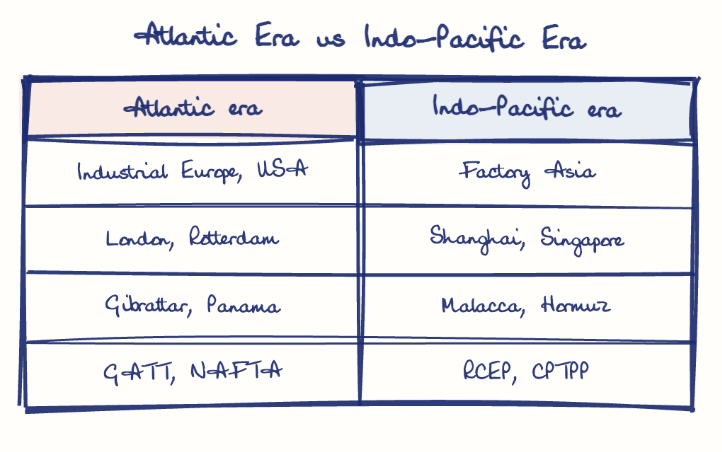
Atlantic Era vs Indo-Pacific Era a: Atlantic era b: Indo-Pacific era → Industrial Europe, USA :: Factory Asia → London, Rotterdam :: Shanghai, Singapore → Gibraltar, Panama :: Malacca, Hormuz → GATT, NAFTA :: RCEP, CPTPP
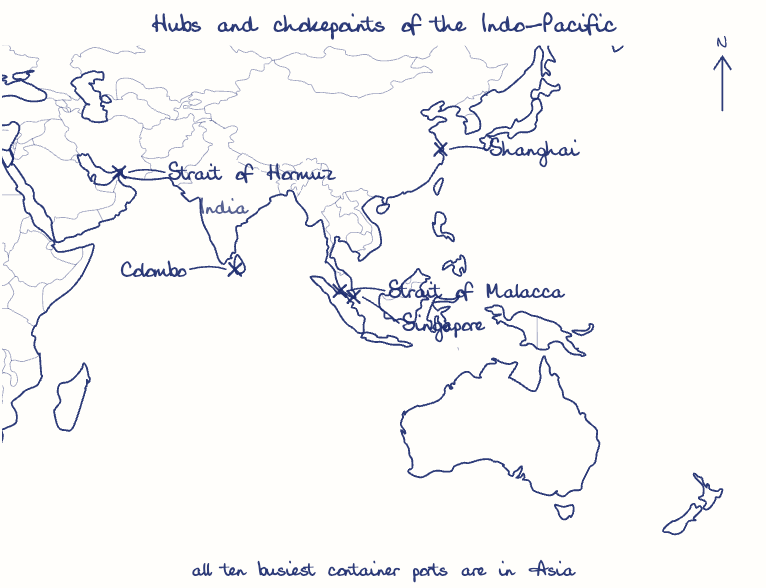
1. Economic weight: The US Indo-Pacific Strategy (2022) notes the region holds over half the world's people and nearly two-thirds of its economy. 2. Factory Asia: China became the largest goods exporter after joining the WTO in 2001, and value chains now run through ASEAN and India. 3. Shipping: All ten of the busiest container ports are Asian, and the Indian Ocean carries about 30% of container cargo (NITI Aayog, 2026). 4. New blocs: RCEP (in force 2022) and the UK's entry into the CPTPP in 2024 anchor rules in the region.
Atlantic depth
EU-US trade in goods and services is still the world's largest bilateral flow, and the dollar and Western capital markets finance most of world trade.
Nearshoring
US-China tariff wars since 2018 pushed firms towards Mexico, which became the top US trading partner in 2023.
Fragile chokepoints
Red Sea attacks from 2023 and the 2026 Gulf conflict exposed Indo-Pacific routes, while IMEC (2023) links both oceans.
This model answer is indicative and the model can make mistakes; please verify key facts independently.
Practise this question
1Get the answer sheet
Sized for this question.
2Write your answer
Timed, by hand.
3Get it marked
Your score and what to fix.
This chapter in the exam
International Trade / Transport and Activities12 questions
Asked in 9 of 14 sittings since 2013
- 2022Mention the significance of straits and isthmus in international trade.
- 2021What are the main socio-economic implications arising out of the development of IT industries in major cities of India ?
All 12 questions, sorted by sub-topic, with model answers and practice.
Question from the official UPSC Civil Services (Main) Examination 2026 paper. Answer written by Ghissu's engine and checked against our editorial standards. Found an error? Tell us and we correct it within 48 hours.