2014 · GS Paper 1 · Q5 · 10 marks
Sufis and medieval mystic saints failed to modify either the religious ideas and practices or the outward structure of Hindu/Muslim societies to any appreciable extent. Comment.
In short
The claim that Sufi and Bhakti saints changed little holds largely for social structure, since caste, the sharia and patriarchy outlived them, but not for religious ideas and practice. They shifted worship to personal devotion and, through Guru Nanak, founded Sikhism with its langar and the Adi Granth (1604).
Model answer
Ghissu Editorial · Verified 4 Oct 2026 · 282 words
Caste survived devotion
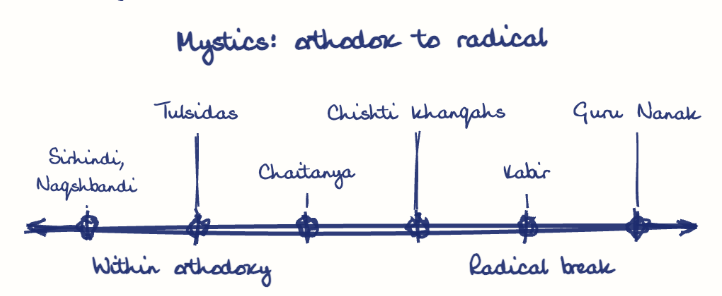
Kabir and Ravidas mocked caste, yet their followers hardened into caste-like sects such as the Kabirpanthis.
Saguna bhakti stayed orthodox
Tulsidas's Ramcharitmanas upheld varnashrama dharma, keeping Vaishnava devotion inside the Brahmanical fold.
Sufis within the sharia
The Naqshbandi Shaikh Ahmad Sirhindi reasserted orthodoxy, and the ulama kept control of Muslim law and ritual.
Aloof and patriarchal
Chishtis like Nizamuddin Auliya shunned the court, so their ethic never became state policy, and women saints like Mirabai and Lal Ded stayed exceptions in a patriarchal order.
Devotion over ritual
Worship shifted from priest and sacrifice to personal devotion, kirtan and sama.
A new faith
Guru Nanak's sangat and langar founded a community, and the Adi Granth (1604) placed Kabir and Sheikh Farid beside the Gurus.
Shared spaces and languages
Ajmer Sharif and the Varkari pilgrimage to Pandharpur drew all faiths and castes, including the Mahar saint Chokhamela, while saints wrote in Hindavi, Marathi and Punjabi, carrying devotion to ordinary people in their own tongues.
This model answer is indicative and the model can make mistakes; please verify key facts independently.
Practise this question
1Get the answer sheet
Sized for this question.
2Write your answer
Timed, by hand.
3Get it marked
Your score and what to fix.
This chapter in the exam
Indian Culture - Medieval Times5 questions
Asked in 5 of 14 sittings since 2013
- 2025Examine the main aspects of Akbar's religious syncretism.
- 2023What were the major technological changes introduced during the Sultanate period? How did those technological changes influence the Indian society?
All 5 questions, sorted by sub-topic, with model answers and practice.
Question from the official UPSC Civil Services (Main) Examination 2014 paper. Answer written by Ghissu's engine and checked against our editorial standards. Found an error? Tell us and we correct it within 48 hours.