2025 · GS Paper 1 · Q2 · 10 marks
Examine the main aspects of Akbar's religious syncretism.
In short
Akbar's religious syncretism combined equal treatment of subjects, inter-faith dialogue at the Ibadat Khana, imperial authority over the ulema and a shared court culture, all under the principle of sulh-i-kul. His Din-i-Ilahi of 1582 was a small discipleship order that did not survive him.
Model answer
Ghissu Editorial · Verified 4 Oct 2026 · 279 words
Equal subjects
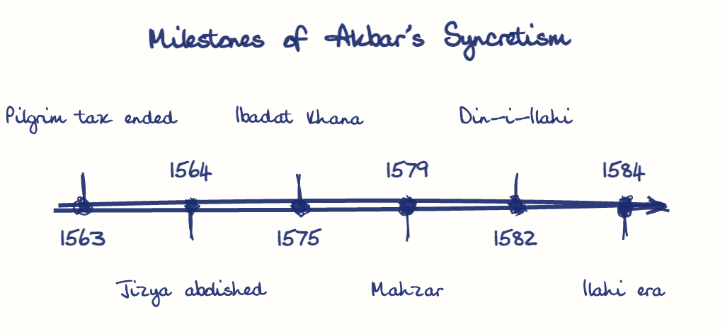
Abolishing the pilgrim tax (1563) and the jizya (1564) ended fiscal discrimination, and Hindus such as Raja Man Singh and Raja Todar Mal held high mansabs.
Dialogue of faiths
The Ibadat Khana at Fatehpur Sikri, open to all faiths from 1578, heard Brahmins, Jain teachers, the Parsi Dastur Meherji Rana and Jesuits such as Rodolfo Acquaviva.
Emperor above the ulema
The Mahzar of 1579 made Akbar, as Imam-i-Adil, the arbiter between conflicting juristic opinions.
Shared culture
The Maktab Khana's Razmnama rendered the Mahabharata into Persian, and the court celebrated Nauroz and Diwali and adopted the solar Ilahi calendar.
A personal path
Din-i-Ilahi (1582) was a discipleship order of a few nobles such as Birbal, never a state religion imposed on subjects.
Statecraft
Sulh-i-kul bound Rajputs, Iranis and Turanis to the throne, so it served stability as much as conviction.
Backlash and decline
Badauni's Muntakhab-ut-Tawarikh and Shaikh Ahmad Sirhindi's Naqshbandi revival opposed the policy, and the order did not survive Akbar.
This model answer is indicative and the model can make mistakes; please verify key facts independently.
Practise this question
1Get the answer sheet
Sized for this question.
2Write your answer
Timed, by hand.
3Get it marked
Your score and what to fix.
This chapter in the exam
Indian Culture - Medieval Times5 questions
Asked in 5 of 14 sittings since 2013
- 2023What were the major technological changes introduced during the Sultanate period? How did those technological changes influence the Indian society?
- 2018The Bhakti movement received a remarkable re-orientation with the advent of Sri Chaitanya Mahaprabhu. Discuss.
All 5 questions, sorted by sub-topic, with model answers and practice.
Question from the official UPSC Civil Services (Main) Examination 2025 paper. Answer written by Ghissu's engine and checked against our editorial standards. Found an error? Tell us and we correct it within 48 hours.