2014 · GS Paper 1 · Q3 · 10 marks
Taxila university was one of the oldest universities of the world with which were associated a number of renowned learned personalities of different disciplines. Its strategic location caused its fame to flourish, but unlike Nalanda, it is not considered as a university in the modern sense. Discuss.
In short
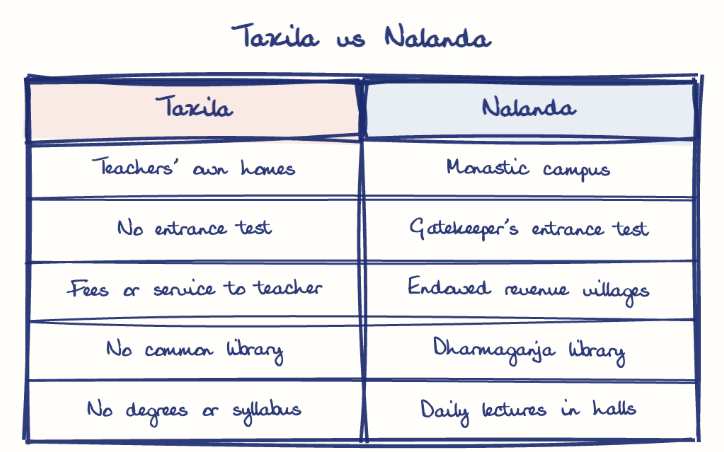
Taxila drew scholars such as Panini, Kautilya and Jivaka because it lay on the Uttarapatha at the meeting of Central Asian and Indian routes, but its teachers taught independently in their homes. Unlike Nalanda, it had no campus, entrance test, endowment or corporate body.
Model answer
Ghissu Editorial · Verified 4 Oct 2026 · 301 words
Renowned scholars
Tradition links Panini, Kautilya and Jivaka, physician to Bimbisara, with Taxila, and Pali texts say Prasenajit of Kosala studied there.
Range of disciplines
The Vedas, the eighteen sippas, medicine, law and military science drew princes and commoners alike.
Gateway location
As Gandhara's capital on the Uttarapatha, where roads from Bactria, Persia and Central Asia met the Gangetic plain, it absorbed ideas under Achaemenid, Mauryan, Indo-Greek and Kushana rule until Huna raids in the 5th century CE.
Teacher-centred system
Each acharya taught a few pupils in his own home, set his own course and took a fee or service, with no corporate body, examination or degree, as A.S. Altekar noted.
Nalanda's institutional form
Nalanda (5th century CE, under Kumaragupta I) had monasteries, an entrance test, endowed villages and, per Xuanzang, about 10,000 students and 1,500 teachers.
Higher learning in substance
Pupils came after basic schooling for specialised study, so Taxila was advanced in content if not in structure.
This model answer is indicative and the model can make mistakes; please verify key facts independently.
Practise this question
1Get the answer sheet
Sized for this question.
2Write your answer
Timed, by hand.
3Get it marked
Your score and what to fix.
This chapter in the exam
Literature5 questions
Asked in 5 of 14 sittings since 2013
- 2024Estimate the contribution of Pallavas of Kanchi for the development of art and literature of South India.
- 2021Evaluate the nature of the Bhakti literature and its contribution to Indian culture.
All 5 questions, sorted by sub-topic, with model answers and practice.
Question from the official UPSC Civil Services (Main) Examination 2014 paper. Answer written by Ghissu's engine and checked against our editorial standards. Found an error? Tell us and we correct it within 48 hours.