2014 · GS Paper 2 · Q11 · 12 marks
Do government's schemes for up-lifting vulnerable and backward communities by protecting required social resources for them, lead to their exclusion in establishing businesses in urban economies ?
In short
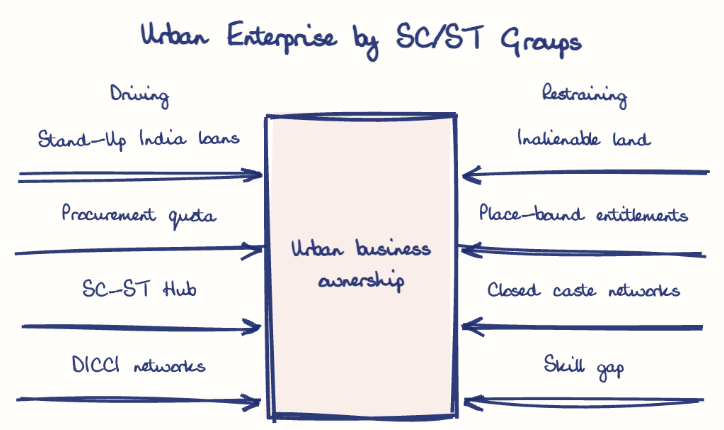
Protective schemes contribute only partly to the exclusion of vulnerable groups from urban business, through inalienable land and village-bound entitlements, while capital, networks and caste prejudice matter more. Stand-Up India (2016) and the 4% procurement quota for SC/ST-owned firms show the shift from protection to promotion.
Model answer
Ghissu Editorial · Verified 4 Oct 2026 · 290 words
Locked assets
Bars on transferring tribal land, upheld in Samatha v State of Andhra Pradesh (1997), make that land unusable as collateral for bank credit.
Place-bound entitlements
Ration cards, MGNREGA job cards and FRA 2006 rights are tied to the village, so migrants lost the safety net until One Nation One Ration Card (2019).
Job-centred mobility
Reservation steers aspiration toward government jobs, while caste-based business networks stay closed, as Harish Damodaran's India's New Capitalists (2008) shows.
Older barriers
Iyer, Khanna and Varshney (2013) documented a persistent SC/ST ownership gap, one that tracks low capital, education and networks rather than welfare protection.
Credit and markets
Stand-Up India (2016) mandates loans of ₹10 lakh to ₹1 crore for SC/ST and women entrepreneurs, and the Public Procurement Policy reserves 4% of central purchases for SC/ST-owned firms.
Urban poor
DAY-NULM self-employment loans and PM SVANidhi (2020) help street vendors and the urban poor start businesses.
This model answer is indicative and the model can make mistakes; please verify key facts independently.
Practise this question
1Get the answer sheet
Sized for this question.
2Write your answer
Timed, by hand.
3Get it marked
Your score and what to fix.
This chapter in the exam
Welfare Schemes9 questions
Asked in 6 of 14 sittings since 2013
- 2023"Development and welfare schemes for the vulnerable, by its nature, are discriminatory in approach." Do you agree ? Give reasons for your answer.
- 2022Reforming the government delivery system through the Direct Benefit Transfer Scheme is a progressive step, but it has its limitations too. Comment.
All 9 questions, sorted by sub-topic, with model answers and practice.
Question from the official UPSC Civil Services (Main) Examination 2014 paper. Answer written by Ghissu's engine and checked against our editorial standards. Found an error? Tell us and we correct it within 48 hours.