2014 · GS Paper 2 · Q5 · 12 marks
Instances of President's delay in commuting death sentences has come under public debate as denial of justice. Should there be a time limit specified for the President to accept/reject such petitions? Analyze.
In short
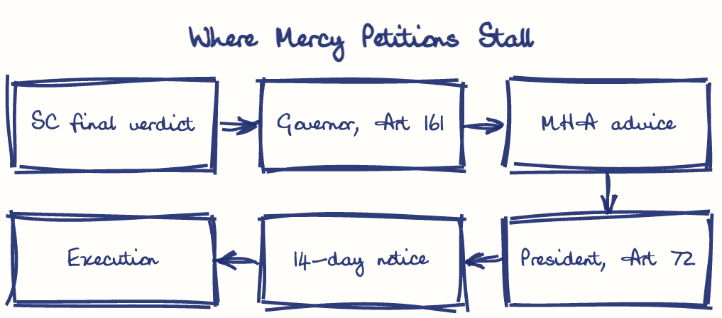
A rigid constitutional deadline for mercy petitions is unwise, but an outer limit per executive stage, with recorded reasons, should be set in Home Ministry rules. Shatrughan Chauhan (2014) commuted 13 death sentences because unexplained delay in deciding petitions under Article 72 violated Article 21.
Model answer
Ghissu Editorial · Verified 4 Oct 2026 · 280 words
Executive delay
The President acts on Home Ministry advice (Maru Ram, 1980), so files idle; Rajiv Gandhi's assassins waited about eleven years.
Article 21 violated
Triveniben (1989) held that prolonged delay can make execution unjust, and V. Sriharan (2014) commuted those sentences.
Arbitrariness
Afzal Guru's petition waited from 2006 to 2013, and his family learnt of the rejection only after the execution, offending Article 14.
Victims too
Indefinite pendency erodes faith in the criminal process and denies families a final answer.
For a deadline
It would end the "death row phenomenon" and make the Shatrughan Chauhan safeguards, such as a 14-day gap before execution, binding.
Against rigidity
Article 72 is a plenary power of grace, and Kehar Singh (1989) let the President re-examine the whole record.
Separation of powers
The November 2025 Presidential Reference opinion refused judicial timelines on assent, signalling restraint on clemency too.
Speed is possible
The Nirbhaya convicts' petitions were decided within days in 2020.
This model answer is indicative and the model can make mistakes; please verify key facts independently.
Practise this question
1Get the answer sheet
Sized for this question.
2Write your answer
Timed, by hand.
3Get it marked
Your score and what to fix.
This chapter in the exam
Union Executive — President, VP, PM, Ministries & Departments3 questions
Asked in 2 of 14 sittings since 2013
- 2022Discuss the role of the Vice-President of India as the Chairman of the Rajya Sabha.
- 2014The size of the cabinet should be as big as government work justifies and as big as the Prime Minister can manage as a team. How far is the efficacy of a government then inversely related to the size of the cabinet? Discuss.
Question from the official UPSC Civil Services (Main) Examination 2014 paper. Answer written by Ghissu's engine and checked against our editorial standards. Found an error? Tell us and we correct it within 48 hours.