2014 · GS Paper 2 · Q6 · 12 marks
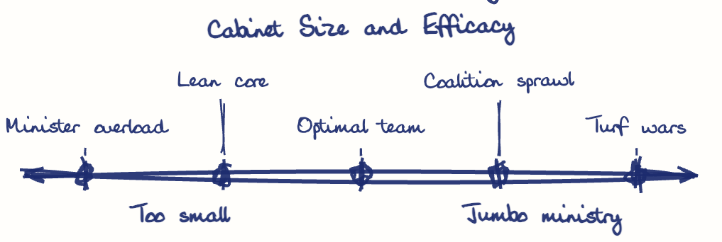
The size of the cabinet should be as big as government work justifies and as big as the Prime Minister can manage as a team. How far is the efficacy of a government then inversely related to the size of the cabinet? Discuss.
In short
Government efficacy is only partly and non-linearly related to cabinet size: oversized councils raise coordination costs and patronage, but too small a cabinet cannot carry the workload. The 91st Amendment caps ministers at 15% of the Lok Sabha, while structure and merit decide performance.
Model answer
Ghissu Editorial · Verified 4 Oct 2026 · 284 words
Coordination costs
Span-of-control theory holds that a leader directs only a few close colleagues well, so real decisions shift to Cabinet Committees such as the CCS.
Fragmented portfolios
Splitting related subjects breeds turf wars, which the Second ARC's 13th Report (2009) sought to cure with about 20-25 coherent ministries.
Patronage over performance
Jumbo ministries reward allies over competence, and parliamentary secretaries used to dodge the cap were struck down in Bimolangshu Roy (2017).
Weaker collective responsibility
A large council rarely deliberates as one body, so Article 75(3) works through a small inner cabinet.
Workload justifies size
Expanding welfare, digital and security functions need supervision, as the Ministry of Cooperation (2021) shows.
Structure beats number
Merging ministries, as Jal Shakti did in 2019, improves delivery even in a large council.
Representation as legitimacy
In a diverse, coalition polity, a broad council binds regions and partners to the government.
Comparative evidence
Britain's Cabinet of about 22 works through strong secretariats, not size alone.
This model answer is indicative and the model can make mistakes; please verify key facts independently.
Practise this question
1Get the answer sheet
Sized for this question.
2Write your answer
Timed, by hand.
3Get it marked
Your score and what to fix.
This chapter in the exam
Union Executive — President, VP, PM, Ministries & Departments3 questions
Asked in 2 of 14 sittings since 2013
- 2022Discuss the role of the Vice-President of India as the Chairman of the Rajya Sabha.
- 2014Instances of President's delay in commuting death sentences has come under public debate as denial of justice. Should there be a time limit specified for the President to accept/reject such petitions? Analyze.
Question from the official UPSC Civil Services (Main) Examination 2014 paper. Answer written by Ghissu's engine and checked against our editorial standards. Found an error? Tell us and we correct it within 48 hours.