2014 · GS Paper 2 · Q9 · 12 marks
National Human Rights Commission (NHRC) in India can be most effective when its tasks are adequately supported by other mechanisms that ensure the accountability of a government. In light of above observation assess the role of NHRC as an effective complement to the judiciary and other institutions in promoting and protecting human rights standards.
In short
The NHRC is an effective complement to the judiciary and other commissions, widening access to justice and feeding courts with findings, but its impact depends on government compliance. In Paramjit Kaur (1996) the Supreme Court entrusted it with the Punjab mass cremations matter.
Model answer
Ghissu Editorial · Verified 4 Oct 2026 · 277 words
Accessible forum
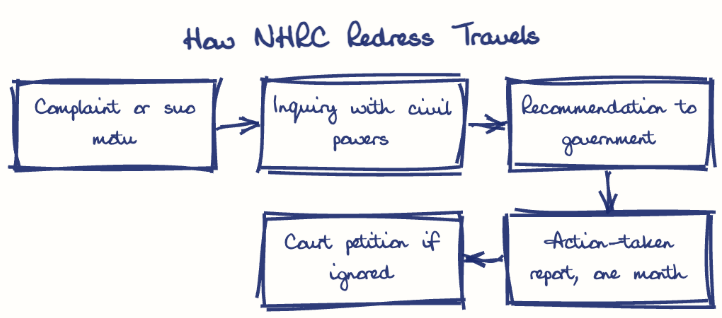
It inquires suo motu or on a petition with civil court powers, offering poor victims a free and faster remedy than litigation.
Aid to courts
In Paramjit Kaur (1996) the Supreme Court entrusted it with the Punjab mass cremations matter, in which it ordered compensation for victims' families.
Custodial accountability
Its rule that custodial deaths be reported within 24 hours reinforces D.K. Basu (1997) and the encounter norms of PUCL v. State of Maharashtra (2014).
Coordinating hub
Chairpersons of the NCW, NCSC, NCST, NCM, NCBC and NCPCR are deemed members, linking rights work across groups.
Policy prod
Its advisory on transgender persons, issued after visiting Garima Greh shelters under the SMILE scheme, pressed ministries to close welfare gaps.
Structural limits
A one-year limit on complaints, only a reporting role over the armed forces, borrowed investigators and GANHRI's 2023 deferral of its 'A' status show how far it depends on others.
This model answer is indicative and the model can make mistakes; please verify key facts independently.
Practise this question
1Get the answer sheet
Sized for this question.
2Write your answer
Timed, by hand.
3Get it marked
Your score and what to fix.
This chapter in the exam
Statutory Bodies6 questions
Asked in 5 of 14 sittings since 2013
- 2023Who are entitled to receive free legal aid ? Assess the role of the National Legal Services Authority (NALSA) in rendering free legal aid in India.
- 2023Discuss the role of the Competition Commission of India in containing the abuse of dominant position by the Multi-National Corporations in India. Refer to the recent decisions.
All 6 questions, sorted by sub-topic, with model answers and practice.
Question from the official UPSC Civil Services (Main) Examination 2014 paper. Answer written by Ghissu's engine and checked against our editorial standards. Found an error? Tell us and we correct it within 48 hours.