2014 · GS Paper 2 · Q1 · 12 marks
Starting from inventing the basic structure doctrine, the judiciary has played a highly proactive role in ensuring that India develops into a thriving democracy. In light of the statement, evaluate the role played by judicial activism in achieving the ideals of democracy.
In short
Judicial activism has largely advanced Indian democracy by protecting the basic structure, expanding rights and cleaning up elections, though it sometimes strays into policymaking. Indira Gandhi v. Raj Narain (1975) made free and fair elections part of the basic structure.
Model answer
Ghissu Editorial · Verified 4 Oct 2026 · 288 words
Guarding the framework
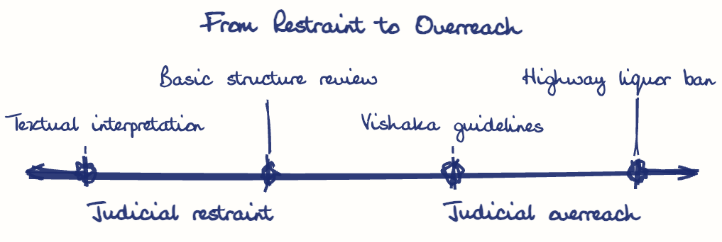
Indira Gandhi v. Raj Narain (1975) made free elections part of the basic structure, and S.R. Bommai (1994) curbed misuse of Article 356.
Expanding liberty
Maneka Gandhi (1978) demanded "fair, just and reasonable" procedure, and Puttaswamy (2017) recognised privacy as a fundamental right.
Voice for the voiceless
Hussainara Khatoon (1979) freed thousands of undertrials, and S.P. Gupta (1981) relaxed locus standi.
Cleaner elections
ADR (2002) mandated candidate disclosures, PUCL (2013) gave NOTA, and the 2024 electoral bonds verdict upheld voters' right to know.
Policy by courts
The 2016 highway liquor ban and the cinema anthem order were policy choices that belonged to elected bodies, not courts.
Self-referential independence
Striking down the NJAC (2015) despite its passage by Parliament and ratification by the States kept appointments within the judiciary and raised the question of who judges the judges.
Limits of enforcement
Prakash Singh (2006) police reforms remain largely unimplemented, showing courts can order but not administer, and ADM Jabalpur (1976) shows activism depends on individual benches.
This model answer is indicative and the model can make mistakes; please verify key facts independently.
Practise this question
1Get the answer sheet
Sized for this question.
2Write your answer
Timed, by hand.
3Get it marked
Your score and what to fix.
This chapter in the exam
Structure, Organization and Functioning of the Union Judiciary7 questions
Asked in 7 of 14 sittings since 2013
- 2026What is meant by judicial legislation ? In this context, discuss the verdicts of the apex court allowing “passive euthanasia” and a “living will”.
- 2024Explain the reasons for the growth of public interest litigation in India. As a result of it, has the Indian Supreme Court emerged as the world's most powerful judiciary?
All 7 questions, sorted by sub-topic, with model answers and practice.
Question from the official UPSC Civil Services (Main) Examination 2014 paper. Answer written by Ghissu's engine and checked against our editorial standards. Found an error? Tell us and we correct it within 48 hours.