2024 · GS Paper 2 · Q14 · 15 marks
Explain the reasons for the growth of public interest litigation in India. As a result of it, has the Indian Supreme Court emerged as the world's most powerful judiciary?
In short
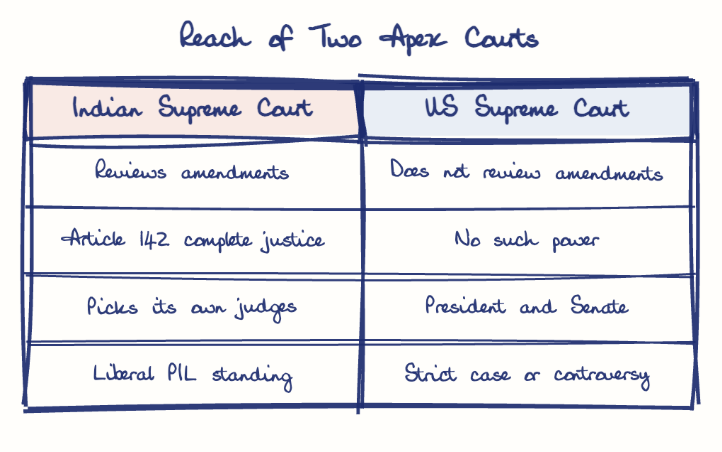
PIL grew from relaxed locus standi after the Emergency, an expanding Article 21 and executive failure, giving the Supreme Court unusual reach over amendments, appointments and governance. It is arguably the world's most expansive apex court, yet weak compliance, as with Prakash Singh (2006), limits its effective power.
Model answer
Ghissu Editorial · Verified 4 Oct 2026 · 307 words
Post-Emergency legitimacy
After ADM Jabalpur (1976), the Court opened Article 32 to the poor and voiceless.
Relaxed procedure
Liberal standing and letter petitions (Sunil Batra, 1980) made litigation cheap.
Expanding Article 21
Livelihood (Olga Tellis, 1985), environment (M.C. Mehta) and food (PUCL, 2001) became justiciable.
Governance failure
Executive inaction on bonded labour (Bandhua Mukti Morcha, 1984) and pollution pushed NGOs, activists and the press to treat courts as the forum of last resort.
Unusual reach
It reviews constitutional amendments (Kesavananda, 1973), struck down the NJAC (2015), ran Delhi's CNG shift (1998) and cancelled 122 2G licences (2012).
Real limits
Weak compliance, as with Prakash Singh's police reforms (2006), legislative override after Anoop Baranwal (2023) and 5.29 crore pending cases (Law Ministry, July 2025) restrain its effective power.
Filter and restrain
Apply the Balwant Singh Chaufal (2010) PIL filters, impose costs on motivated petitions and defer on pure policy.
Statutory handover
Pass supervision to bodies like the Commission for Air Quality Management.
This model answer is indicative and the model can make mistakes; please verify key facts independently.
Practise this question
1Get the answer sheet
Sized for this question.
2Write your answer
Timed, by hand.
3Get it marked
Your score and what to fix.
This chapter in the exam
Structure, Organization and Functioning of the Union Judiciary7 questions
Asked in 7 of 14 sittings since 2013
- 2026What is meant by judicial legislation ? In this context, discuss the verdicts of the apex court allowing “passive euthanasia” and a “living will”.
- 2023Constitutionally guaranteed judicial independence is a prerequisite of democracy. Comment.
All 7 questions, sorted by sub-topic, with model answers and practice.
Question from the official UPSC Civil Services (Main) Examination 2024 paper. Answer written by Ghissu's engine and checked against our editorial standards. Found an error? Tell us and we correct it within 48 hours.