2014 · GS Paper 2 · Q8 · 12 marks
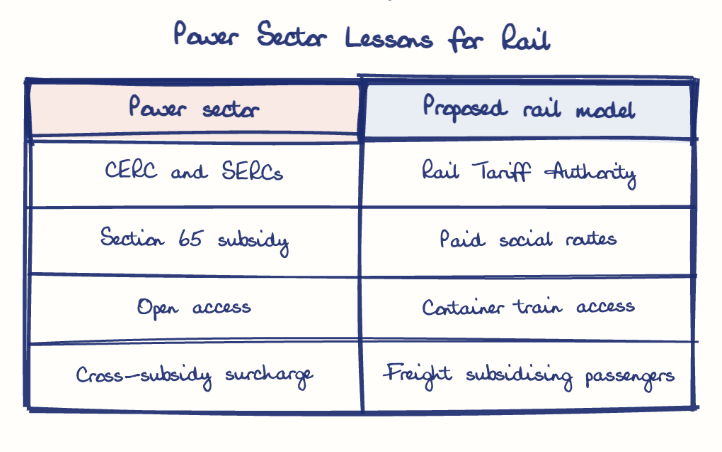
The setting up of a Rail Tariff Authority to regulate fares will subject the cash strapped Indian Railways to demand subsidy for obligation to operate non-profitable routes and services. Taking into account the experience in the power sector, discuss if the proposed reform is expected to benefit the consumers, the Indian Railways or the private container operators.
In short
A Rail Tariff Authority would benefit the Railways and private container operators most directly and consumers through better service, provided it is statutory and social routes are subsidised explicitly. Section 65 of the Electricity Act 2003, which makes states pay power subsidies upfront, is the model to copy.
Model answer
Ghissu Editorial · Verified 4 Oct 2026 · 300 words
Transparent tariffs
Since the Electricity Act 2003, tariffs are set through public hearings and reasoned orders, a predictability that budget-day rail fares never had.
Explicit subsidy
Section 65 makes a state wanting cheaper power pay the subsidy in advance, a model for rail's uneconomic lines.
Limits of autonomy
State commissions often deferred hikes under political pressure, so discom losses needed the 2012 Financial Restructuring Plan.
Consumers
Fares tied to cost and quality become predictable and contestable, though long-frozen suburban and second-class fares may rise.
Indian Railways
Paid social obligations and periodic revisions steady its finances and ease the cross-subsidy that drives freight to roads.
Private container operators
Licensed since 2006, they pay haulage fixed by the Railways, their competitor; a neutral regulator would ensure fair haulage and access.
Binding powers
The advisory Rail Development Authority of 2017 never became functional, so statutory force is essential.
This model answer is indicative and the model can make mistakes; please verify key facts independently.
Practise this question
1Get the answer sheet
Sized for this question.
2Write your answer
Timed, by hand.
3Get it marked
Your score and what to fix.
This chapter in the exam
Regulatory & Quasi-Judicial Bodies5 questions
Asked in 5 of 14 sittings since 2013
- 2021The jurisdiction of the Central Bureau of Investigation (CBI) regarding lodging an FIR and conducting probe within a particular state is being questioned by various States. However, the power of States to withhold consent to the CBI is not absolute. Explain with special reference to the federal character of India.
- 2016What is quasi judicial body? Explain with the help of concrete examples.
All 5 questions, sorted by sub-topic, with model answers and practice.
Question from the official UPSC Civil Services (Main) Examination 2014 paper. Answer written by Ghissu's engine and checked against our editorial standards. Found an error? Tell us and we correct it within 48 hours.