2021 · GS Paper 2 · Q11 · 15 marks
The jurisdiction of the Central Bureau of Investigation (CBI) regarding lodging an FIR and conducting probe within a particular state is being questioned by various States. However, the power of States to withhold consent to the CBI is not absolute. Explain with special reference to the federal character of India.
In short
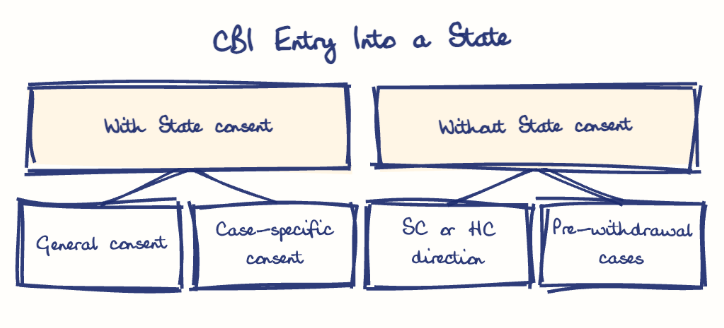
States may withdraw general consent to the CBI under Section 6 of the DSPE Act, but the power is not absolute: constitutional courts can order probes without it and earlier cases continue. A Constitution Bench held so in State of West Bengal v. CPDR (2010).
Model answer
Ghissu Editorial · Verified 4 Oct 2026 · 299 words
Police is a State subject
State List Entry 2 and Union List Entry 80 require a State's consent, which Section 6 mirrors.
Executive control and targeting
The Supreme Court called the CBI a "caged parrot" in 2013, and in West Bengal v. Union of India (2024) it held a State's Article 131 suit maintainable, rejecting the CBI's claimed independence.
Court-ordered probes
In West Bengal v. CPDR (2010) a Constitution Bench allowed the Supreme Court and High Courts to order CBI probes without consent, as in RG Kar (2024).
Prospective withdrawal
Cases registered before withdrawal continue, case-specific consent remains possible, and the NIA can probe scheduled offences without any consent.
Federal balance
India is a "Union of States" (Article 1), and the federalism that S.R. Bommai (1994) made part of the basic structure protects State autonomy without letting consent shield crime.
New CBI law
Define its status and a list of federal offences, with time-bound consent decisions through the Inter-State Council.
Independence
Strengthen the Vineet Narain (1997) safeguards of fixed tenure and CVC oversight.
This model answer is indicative and the model can make mistakes; please verify key facts independently.
Practise this question
1Get the answer sheet
Sized for this question.
2Write your answer
Timed, by hand.
3Get it marked
Your score and what to fix.
This chapter in the exam
Regulatory & Quasi-Judicial Bodies5 questions
Asked in 5 of 14 sittings since 2013
- 2016What is quasi judicial body? Explain with the help of concrete examples.
- 2015For achieving the desired objectives, it is necessary to ensure that the regulatory institutions remain independent and autonomous. Discuss in the light of the experiences in recent past.
All 5 questions, sorted by sub-topic, with model answers and practice.
Question from the official UPSC Civil Services (Main) Examination 2021 paper. Answer written by Ghissu's engine and checked against our editorial standards. Found an error? Tell us and we correct it within 48 hours.