2014 · GS Paper 2 · Q15 · 12 marks
Two parallel run schemes of the Government, viz, the Aadhaar Card and NPR, one as voluntary and the other as compulsory, have led to debates at national levels and also litigations. On merits, discuss whether or not both schemes need run concurrently. Analyse the potential of the schemes to achieve developmental benefits and equitable growth.
In short
Aadhaar and the NPR can run concurrently because they serve different purposes, identity for services and a citizenship-linked population register, but they should share one biometric enrolment. Aadhaar-linked DBT had moved over ₹51 lakh crore by June 2026, though biometric exclusion remains the main equity risk.
Model answer
Ghissu Editorial · Verified 4 Oct 2026 · 295 words
Aadhaar, a voluntary identity number issued by the UIDAI since 2009 by executive order, and the compulsory National Population Register (NPR) under the Citizenship Rules, 2003 overlapped, provoking a Home Ministry and Planning Commission turf war and the Puttaswamy litigation of 2012.
Should Aadhaar and NPR Run Concurrently?
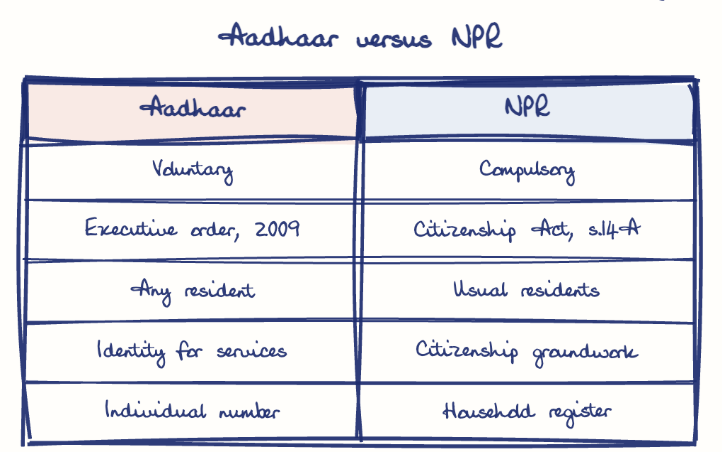
Aadhaar versus NPR a: Aadhaar b: NPR → Voluntary :: Compulsory → Executive order, 2009 :: Citizenship Act, s.14A → Any resident :: Usual residents → Identity for services :: Citizenship groundwork → Individual number :: Household register
1. Different purposes: Aadhaar proves identity but not citizenship, whereas NPR is the base for a citizens' register and security, as the coastal NPR after the 2008 Mumbai attacks showed. 2. Costly duplication: Collecting biometrics twice wastes money, which forced the Cabinet to split enrolment between the two in January 2012. 3. Balanced course: With Supreme Court interim orders (2013, 2014) barring denial of services for lacking Aadhaar, both should run with one data capture, NPR seeding Aadhaar numbers as its 2015 update did.
Leak-proof transfers
Aadhaar-linked accounts power DBT and PAHAL, with over ₹51 lakh crore transferred by June 2026 (New India Samachar, 2026).
Inclusion and planning
Portable identity brings migrants and undocumented people into Jan Dhan accounts and later enabled One Nation One Ration Card, while NPR's household data on education and occupation can sharpen targeting.
Equity risks
Biometric failures, as in the Jharkhand starvation death of Santoshi Kumari (2017), and NPR's citizenship link, which fuelled the 2019-20 protests, can exclude the vulnerable.
This model answer is indicative and the model can make mistakes; please verify key facts independently.
Practise this question
1Get the answer sheet
Sized for this question.
2Write your answer
Timed, by hand.
3Get it marked
Your score and what to fix.
This chapter in the exam
Government Interventions — Schemes & Legislation5 questions
Asked in 4 of 14 sittings since 2013
- 2024What are the aims and objects of recently passed and enforced, The Public Examination (Prevention of Unfair Means) Act, 2024? Whether University/State Education Board examinations, too, are covered under the Act?
- 2015What are the major changes brought in the Arbitration and Conciliation Act, 1996 through the recent Ordinance promulgated by the President? How far will it improve India's dispute resolution mechanism? Discuss.
All 5 questions, sorted by sub-topic, with model answers and practice.
Question from the official UPSC Civil Services (Main) Examination 2014 paper. Answer written by Ghissu's engine and checked against our editorial standards. Found an error? Tell us and we correct it within 48 hours.