2015 · GS Paper 2 · Q6 · 12 marks
What are the major changes brought in the Arbitration and Conciliation Act, 1996 through the recent Ordinance promulgated by the President? How far will it improve India's dispute resolution mechanism? Discuss.
In short
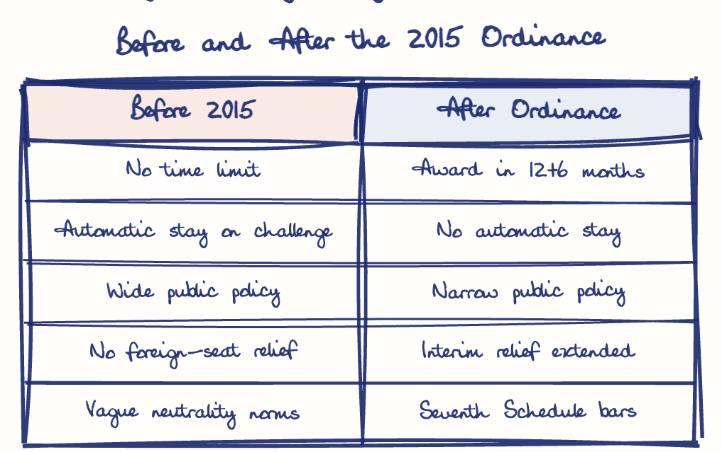
The 2015 Ordinance set a 12-month deadline for awards, ended automatic stays on challenges, narrowed the public policy ground and extended interim relief to foreign-seated arbitrations. It improves speed and finality, but dispute resolution improves only partly while arbitral institutions remain weak.
Model answer
Ghissu Editorial · Verified 4 Oct 2026 · 321 words
Faster appointments
Section 11 vests appointment in the Supreme Court or High Court, limited to checking that an arbitration agreement exists, with disposal within 60 days.
Stronger tribunals and costs
Section 17 interim orders became enforceable like court orders, Section 29B added a six-month fast track on written pleadings, and Section 31A makes the loser generally bear costs, with a model fee scale in the Fourth Schedule.
Speed and finality
Time limits, with fee cuts for delay, and the end of automatic stays target the main delays, and the narrow public policy test reverses the merits review of ONGC v. Saw Pipes (2003).
Investor confidence
Interim relief for foreign-seated arbitrations closes the BALCO (2012) gap, and India rose to 163rd on enforcing contracts by Doing Business 2020.
Limits
The rigid 12-month rule was relaxed in 2019, pending cases needed BCCI v. Kochi Cricket (2018), and ad hoc arbitration and government appeals persist, prompting the Srikrishna Committee (2017) to urge an Arbitration Council of India.
This model answer is indicative and the model can make mistakes; please verify key facts independently.
Practise this question
1Get the answer sheet
Sized for this question.
2Write your answer
Timed, by hand.
3Get it marked
Your score and what to fix.
This chapter in the exam
Government Interventions — Schemes & Legislation5 questions
Asked in 4 of 14 sittings since 2013
- 2024What are the aims and objects of recently passed and enforced, The Public Examination (Prevention of Unfair Means) Act, 2024? Whether University/State Education Board examinations, too, are covered under the Act?
- 2015If amendment bill to the Whistleblowers Protection Act 2011 tabled in the Parliament is passed, there may be no one left to protect. Critically Evaluate.
All 5 questions, sorted by sub-topic, with model answers and practice.
Question from the official UPSC Civil Services (Main) Examination 2015 paper. Answer written by Ghissu's engine and checked against our editorial standards. Found an error? Tell us and we correct it within 48 hours.