2014 · GS Paper 2 · Q20 · 12 marks
WTO is an important international institution where decisions taken affect countries in a profound manner. What is the mandate of WTO and how binding are their decisions? Critically analyse India's stand on the latest round of talks on Food security.
In short
The WTO administers trade agreements, hosts negotiations and settles disputes whose rulings bind members through reverse consensus and authorised retaliation. India held up the Trade Facilitation Agreement in July 2014 until the Bali peace clause shielding its food stockholding was extended indefinitely in November 2014.
Model answer
Ghissu Editorial · Verified 4 Oct 2026 · 278 words
The WTO, created by the Marrakesh Agreement in 1995, covers nearly 98% of world trade (RIS, 2024), and its farm rules collided with India's National Food Security Act, 2013 at the Bali Ministerial in 2013.
Mandate of the WTO and Binding Force of Its Decisions
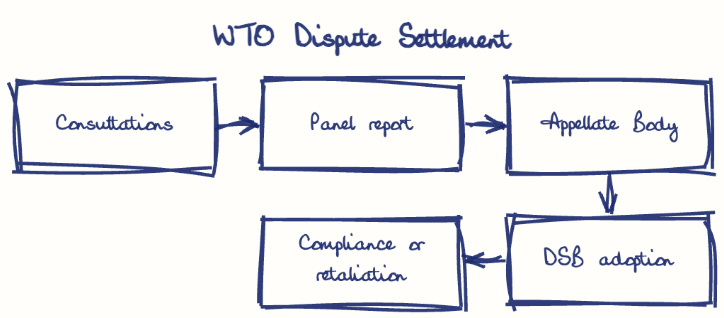
1. Mandate: It administers GATT, GATS, TRIPS and the Agreement on Agriculture on most-favoured-nation and national treatment, hosts negotiations such as the Doha Round, and reviews trade policies. 2. Binding rulings: The Dispute Settlement Understanding adopts rulings by reverse consensus, which is why India amended its patent law in 1999 after the US mailbox dispute.
WTO Dispute Settlement → Consultations → Panel report → Appellate Body → DSB adoption → Compliance or retaliation
3. Limits: Enforcement rests on retaliation that small economies cannot wield, and consensus lets one member stall new rules.
Core demand
India sought to procure grain at MSP for public stocks without breaching the 10% de minimis cap, measured against outdated 1986-88 prices.
Hard bargaining
Since Bali gave only an interim peace clause, India held up the Trade Facilitation Agreement protocol in July 2014 until the November 2014 General Council extended it until a permanent solution.
Balance
The stand was just, since developed members hold about 95% of AMS entitlements (RIS, 2025), but it cost India a deal-breaker image and left onerous notification conditions in place.
This model answer is indicative and the model can make mistakes; please verify key facts independently.
Practise this question
1Get the answer sheet
Sized for this question.
2Write your answer
Timed, by hand.
3Get it marked
Your score and what to fix.
This chapter in the exam
Institutions12 questions
Asked in 10 of 14 sittings since 2013
- 2025"The reform process in the United Nations remains unresolved, because of the delicate imbalance of East and West and entanglement of the USA vs. Russo-Chinese alliance." Examine and critically evaluate the East-West policy confrontations in this regard.
- 2024Terrorism has become a significant threat to global peace and security.' Evaluate the effectiveness of the United Nations Security Council's Counter Terrorism Committee (CTC) and its associated bodies in addressing and mitigating this threat at the international level.
All 12 questions, sorted by sub-topic, with model answers and practice.
Question from the official UPSC Civil Services (Main) Examination 2014 paper. Answer written by Ghissu's engine and checked against our editorial standards. Found an error? Tell us and we correct it within 48 hours.