2014 · GS Paper 3 · Q11 · 12 marks
Can overuse and free availability of antibiotics without Doctor's prescription, be contributors to the emergence of drug-resistant diseases in India? What are the available mechanisms for monitoring and control? Critically discuss the various issues involved.
In short
Overuse and prescription-free sale of antibiotics are major contributors to drug-resistant disease in India, and the control mechanisms are sound on paper but weakly enforced. Schedule H1 (2014), NAP-AMR (2017) and ICMR's surveillance network exist, yet few inspectors and hospital-only data limit them.
Model answer
Ghissu Editorial · Verified 4 Oct 2026 · 272 words
Self-medication
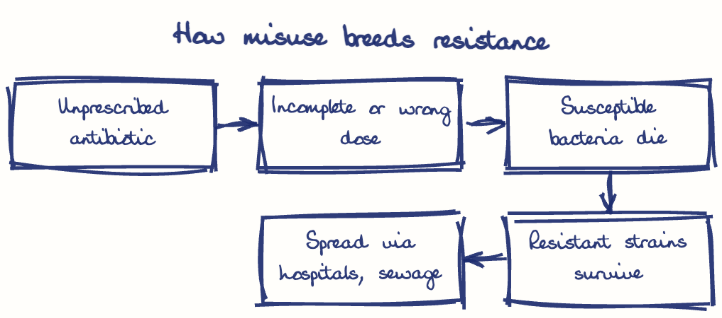
Antibiotics bought over the counter for viral fevers, and courses stopped midway, select the hardiest bacteria.
Irrational prescribing
A 2022 Lancet Regional Health study found many antibiotic FDCs unapproved by the regulator, and 328 irrational FDCs were banned in 2018.
Beyond humans
Colistin used as a poultry growth promoter and pharma effluents near Patancheru spread resistance into food and water.
Regulation
Schedule H1 (2014) requires chemists to record sales of key antibiotics, but too few drug inspectors enforce it.
Policy
The Chennai Declaration (2012) and NAP-AMR (2017), now NAP-AMR 2.0 (2025), adopt One Health, yet few states beyond Kerala (KARSAP, 2018) have funded plans.
Surveillance
ICMR's AMRSN, NCDC's NARS-Net and WHO's GLASS track resistance, mostly in tertiary hospitals, with little animal or environmental data.
Behaviour change
The Red Line campaign (2016), the 2019 colistin ban and Kerala's Operation AMRITH (2024) help, but informal providers and costly diagnostics sustain blind prescribing.
This model answer is indicative and the model can make mistakes; please verify key facts independently.
Practise this question
1Get the answer sheet
Sized for this question.
2Write your answer
Timed, by hand.
3Get it marked
Your score and what to fix.
This chapter in the exam
Developments, Applications and Effects in Everyday Life23 questions
Asked in 13 of 14 sittings since 2013
- 2026Distinguish between a Fast Breeder Reactor (FBR) and a thermal nuclear reactor. In the context of first indigenously developed prototype FBR at Kalpakkam, explain the term 'criticality'. What are its implications for clean energy future of our country? (Answer in 150 words)
- 2025How can India achieve energy independence through clean technology by 2047 ? How can biotechnology play a crucial role in this endeavour ?
All 23 questions, sorted by sub-topic, with model answers and practice.
Question from the official UPSC Civil Services (Main) Examination 2014 paper. Answer written by Ghissu's engine and checked against our editorial standards. Found an error? Tell us and we correct it within 48 hours.