2025 · GS Paper 3 · Q6 · 10 marks
How can India achieve energy independence through clean technology by 2047 ? How can biotechnology play a crucial role in this endeavour ?
In short
India can achieve energy independence by 2047 by pairing renewables, storage, green hydrogen and nuclear power with biotechnology that turns residue and waste into ethanol, biogas and advanced fuels. Non-fossil sources already exceed 259 GW of India's 505 GW installed capacity (PIB, October 2025).
Model answer
Ghissu Editorial · Verified 4 Oct 2026 · 283 words
Renewables with storage
Non-fossil sources form over 259 GW of the 505 GW installed capacity (PIB, October 2025); PLI-backed solar modules and battery storage must make this power firm.
Green hydrogen
The National Green Hydrogen Mission (Rs 19,744 crore) targets 5 million tonnes a year by 2030 to replace grey hydrogen and imported gas in refineries, fertilisers and steel.
Nuclear and minerals
The Nuclear Energy Mission (Union Budget 2025-26) targets 100 GW by 2047 with small modular reactors, and the National Critical Mineral Mission (2025) secures lithium so oil dependence is not swapped for mineral dependence.
Second-generation ethanol
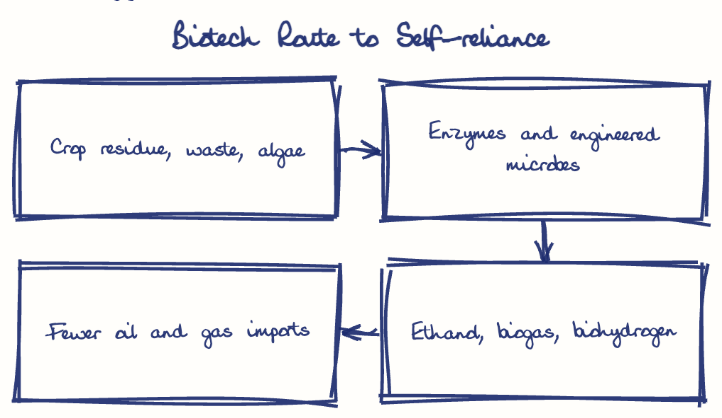
Cellulase enzymes at IOCL's Panipat plant (2022) turn paddy straw into ethanol, a food-safe route to sustain the 20% blending reached in 2025.
Compressed biogas
Anaerobic microbes under SATAT and GOBARdhan turn cattle dung, press mud and urban waste into a domestic substitute for imported LNG.
Advanced fuels and bio-mining
Algae and microbes can yield aviation fuel and biohydrogen, while microbial bioleaching recovers critical metals from e-waste, with the BioE3 Policy (2024) backing such biomanufacturing.
This model answer is indicative and the model can make mistakes; please verify key facts independently.
Practise this question
1Get the answer sheet
Sized for this question.
2Write your answer
Timed, by hand.
3Get it marked
Your score and what to fix.
This chapter in the exam
Developments, Applications and Effects in Everyday Life23 questions
Asked in 13 of 14 sittings since 2013
- 2026Distinguish between a Fast Breeder Reactor (FBR) and a thermal nuclear reactor. In the context of first indigenously developed prototype FBR at Kalpakkam, explain the term 'criticality'. What are its implications for clean energy future of our country? (Answer in 150 words)
- 2025The fusion energy programme in India has steadily evolved over the past few decades. Mention India's contributions to the international fusion energy project – International Thermonuclear Experimental Reactor (ITER). What will be the implications of the success of this project for the future of global energy ?
All 23 questions, sorted by sub-topic, with model answers and practice.
Question from the official UPSC Civil Services (Main) Examination 2025 paper. Answer written by Ghissu's engine and checked against our editorial standards. Found an error? Tell us and we correct it within 48 hours.