2014 · GS Paper 3 · Q6 · 12 marks
Capitalism has guided the world economy to unprecedented prosperity. However, it often encourages short-sightedness and contributes to wide disparities between the rich and the poor. In this light, would it be correct to believe and adopt capitalism for bringing inclusive growth in India? Discuss.
In short
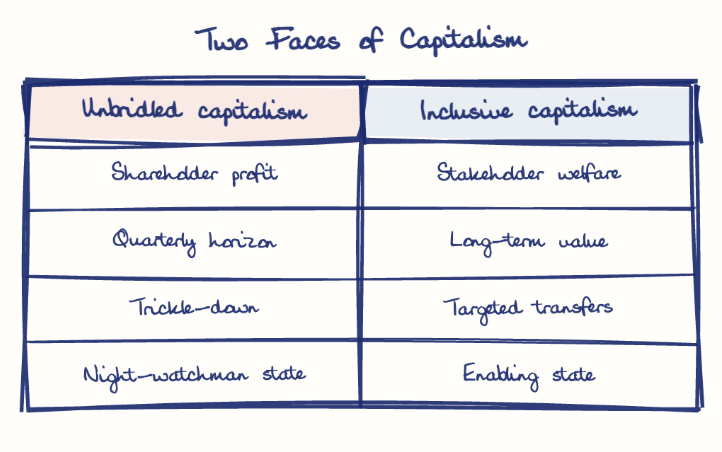
Capitalism should be adopted in India only in a regulated, welfare-backed form, because markets fund welfare and innovation but breed short-termism, cronyism and inequality. The World Inequality Lab estimates the top 1% took 22.6% of national income in 2022-23, even as poverty fell after 1991.
Model answer
Ghissu Editorial · Verified 4 Oct 2026 · 288 words
Growth funds welfare
Near 9% growth in the mid-2000s generated the revenue that paid for MGNREGA and food security.
Mass consumer gains
Private telecom competition made mobile data cheap enough to carry UPI payments for vendors and farmers.
Enterprise and mobility
IT services and one of the world's three largest startup ecosystems opened careers to small-town youth.
Serving the poor
As C.K. Prahalad's bottom-of-the-pyramid thesis argued, sachet goods and microfinance show markets reaching low-income buyers.
Short-termism
The pursuit of quarterly returns fed the 2008 crisis and the 2018 IL&FS collapse while starving health and skills.
Widening disparities
Returns to capital outpace overall growth, as Piketty showed, and about 90% of workers remain informal.
Crony capture
The 2G spectrum and coal block allocations, cancelled by the Supreme Court in 2012 and 2014, show markets bending to political ties.
Uneven growth
Capital-intensive growth clusters in a few states, while about 46% of workers remain in low-income farming (PLFS 2023-24).
This model answer is indicative and the model can make mistakes; please verify key facts independently.
Practise this question
1Get the answer sheet
Sized for this question.
2Write your answer
Timed, by hand.
3Get it marked
Your score and what to fix.
This chapter in the exam
Inclusive Growth11 questions
Asked in 9 of 14 sittings since 2013
- 2026Examine the view that financial inclusion is an integral part of social and economic inclusion in a country like India. Also throw light on the usefulness of the R.B.I.'s Financial Inclusion Index. (Answer in 150 words)
- 2023Distinguish between 'care economy' and 'monetized economy'. How can care economy be brought into monetized economy through women empowerment?
All 11 questions, sorted by sub-topic, with model answers and practice.
Question from the official UPSC Civil Services (Main) Examination 2014 paper. Answer written by Ghissu's engine and checked against our editorial standards. Found an error? Tell us and we correct it within 48 hours.