2014 · GS Paper 3 · Q9 · 12 marks
Foreign Direct Investment (FDI) in the defence sector is now set to be liberalized. What influence this is expected to have on Indian defence and economy in the short and long run?
In short
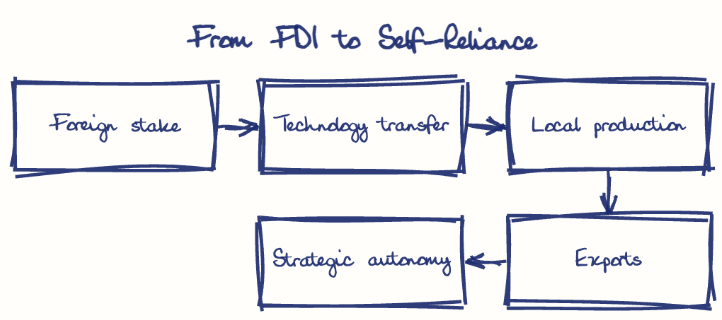
Liberalising defence FDI brought only modest capital and component joint ventures in the short run, while its long-run influence lies in indigenous production, exports, jobs and strategic autonomy. Defence production reached a record of about ₹1.5 lakh crore in 2024-25, according to PIB.
Model answer
Ghissu Editorial · Verified 4 Oct 2026 · 276 words
Modest inflow
Foreign firms were wary of minority stakes, so early FDI stayed small and SIPRI still ranked India the largest arms importer in 2019-23, with 9.8% of global imports.
Joint ventures
New partnerships were expected to begin with component work, extending the pre-2014 model of Tata Advanced Systems building C-130J parts with Lockheed Martin.
Private entry
Tata, L&T and Bharat Forge entered defence, alongside about 16,000 MSMEs in the supply chain (PIB, 2025), though every proposal still needed security clearance.
Indigenous capacity
With 74% FDI under the automatic route from 2020, defence production reached a record of about ₹1.5 lakh crore in 2024-25 (PIB).
Export hub
BrahMos Aerospace, an India-Russia venture, sold missiles to the Philippines in 2022, and defence exports reached ₹23,622 crore in 2024-25.
Spillovers and limits
The Tata-Airbus C-295 line at Vadodara (2024) builds aerospace skills, but jet engine technology stays with foreign partners, as the GE F414 talks with HAL show.
This model answer is indicative and the model can make mistakes; please verify key facts independently.
Practise this question
1Get the answer sheet
Sized for this question.
2Write your answer
Timed, by hand.
3Get it marked
Your score and what to fix.
This chapter in the exam
Liberalization9 questions
Asked in 6 of 14 sittings since 2013
- 2025What are the challenges before the Indian economy when the world is moving away from free trade and multilateralism to protectionism and bilateralism ? How can these challenges be met ?
- 2018How would the recent phenomena of protectionism and currency manipulations in world trade affect macroeconomic stability of India?
All 9 questions, sorted by sub-topic, with model answers and practice.
Question from the official UPSC Civil Services (Main) Examination 2014 paper. Answer written by Ghissu's engine and checked against our editorial standards. Found an error? Tell us and we correct it within 48 hours.