2014 · GS Paper 3 · Q12 · 12 marks
In a globalized world, Intellectual Property Rights assume significance and are a source of litigation. Broadly distinguish between the terms—Copyrights, Patents and Trade Secrets.
In short
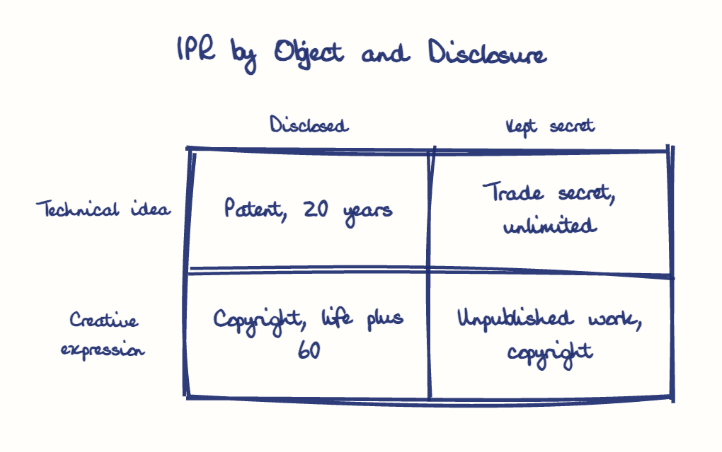
Copyright protects original expression automatically, a patent protects a disclosed invention after examination, and a trade secret protects confidential information only while it stays secret. Copyright lasts life plus 60 years, a patent 20 years, and a trade secret indefinitely until it leaks.
Model answer
Ghissu Editorial · Verified 4 Oct 2026 · 280 words
Copyright
Original expression, such as books, music, films and software code, not the idea itself; it arises automatically under the Copyright Act, 1957.
Patent
A new, inventive, industrially applicable product or process, granted after examination under the Patents Act, 1970 in exchange for public disclosure.
Trade secret
Confidential business information, such as Coca-Cola's formula, protected only through contracts, breach of confidence and Article 39 of TRIPS, as India has no statute.
Duration
Life plus 60 years for copyright, 20 years for a patent, and indefinitely for a trade secret until it leaks.
Strength
A patent bars even independent inventors, copyright bars only copying, and a trade secret falls to independent discovery or reverse engineering.
Limits and disputes
Fair dealing (the DU case), compulsory licensing (Natco v Bayer, 2012) and section 27 of the Contract Act, which voids non-competes, limit each right; the Law Commission's 289th Report (2024) proposed a dedicated trade secrets law.
This model answer is indicative and the model can make mistakes; please verify key facts independently.
Practise this question
1Get the answer sheet
Sized for this question.
2Write your answer
Timed, by hand.
3Get it marked
Your score and what to fix.
This chapter in the exam
Intellectual Property Rights5 questions
Asked in 5 of 14 sittings since 2013
- 2024What is the present world scenario of intellectual property rights with respect to life materials? Although, India is second in the world to file patents, still only a few have been commercialized. Explain the reasons behind this less commercialization.
- 2019How is the Government of India protecting traditional knowledge of medicine from patenting by pharmaceutical companies?
All 5 questions, sorted by sub-topic, with model answers and practice.
Question from the official UPSC Civil Services (Main) Examination 2014 paper. Answer written by Ghissu's engine and checked against our editorial standards. Found an error? Tell us and we correct it within 48 hours.