2014 · GS Paper 3 · Q4 · 12 marks
"In the villages itself no form of credit organization will be suitable except the cooperative society." —All India Rural Credit Survey. Discuss this statement in the background of agricultural finance in India. What constraints and challenges do financial institutions supplying agricultural finance face? How can technology be used to better reach and serve rural clients?
In short
The Rural Credit Survey's faith in cooperatives holds in spirit, but India now needs digitised PACS working alongside banks and fintech, since lenders face collateral gaps, waivers and high costs. The RBI Innovation Hub's digital Kisan Credit Card pilot since 2023 shows how technology can cut costs and reach farmers.
Model answer
Ghissu Editorial · Verified 4 Oct 2026 · 274 words
Local advantage
A PACS lends against crop and character and recovers through peer pressure, which suits the village.
Mixed record
Elite capture and politicised waivers weakened PACS, prompting the Vaidyanathan Committee (2004) revival package and a multi-agency system of commercial banks, RRBs (1975) and NABARD (1982).
Revival underway
The Ministry of Cooperation (2021) had sanctioned computerisation of 73,492 PACS by mid-2025 (PIB).
Collateral gaps
Tenants and women farmers without land titles miss Kisan Credit Card loans.
Risk and waivers
Monsoon risk and waivers such as Uttar Pradesh's in 2017 raise defaults and hurt repayment culture.
Cost and control
Small loans are costly, and cooperative banks faced dual control until the Banking Regulation (Amendment) Act, 2020.
Paperless lending
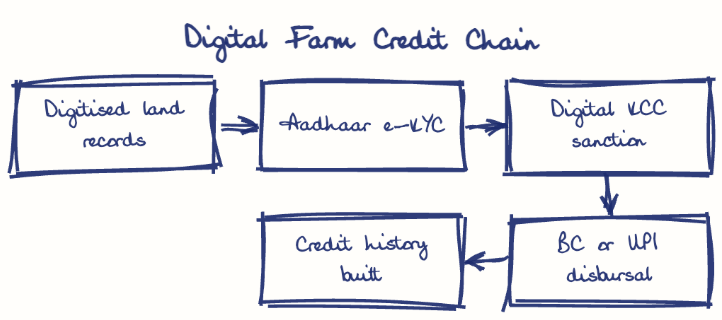
The RBI Innovation Hub's frictionless credit platform has piloted digital KCC loans since 2023, pulling land records through APIs.
Last-mile delivery
Business correspondents, Jan Dhan and UPI helped lift the RBI's Financial Inclusion Index to 67.0 in March 2025.
Data for risk
AgriStack farmer IDs (2024) and satellite crop data help lenders price risk.
This model answer is indicative and the model can make mistakes; please verify key facts independently.
Practise this question
1Get the answer sheet
Sized for this question.
2Write your answer
Timed, by hand.
3Get it marked
Your score and what to fix.
This chapter in the exam
Farm Subsidies and Minimum Support Prices8 questions
Asked in 8 of 14 sittings since 2013
- 2026Discuss the different types of subsidies and supports provided by the Government of India to agricultural sector. Examine the related issues pertaining to Agreement on Agriculture of World Trade Organisation (WTO). (Answer in 250 words)
- 2023What are the direct and indirect subsidies provided to farm sector in India? Discuss the issues raised by the World Trade Organization (WTO) in relation to agricultural subsidies.
All 8 questions, sorted by sub-topic, with model answers and practice.
Question from the official UPSC Civil Services (Main) Examination 2014 paper. Answer written by Ghissu's engine and checked against our editorial standards. Found an error? Tell us and we correct it within 48 hours.