2014 · GS Paper 3 · Q17 · 12 marks
International civil aviation laws provide all countries complete and exclusive sovereignty over the airspace above their territory. What do you understand by 'airspace'? What are the implications of these laws on the space above this airspace? Discuss the challenges which this poses and suggest ways to contain the threat.
In short
Airspace is the sovereign air column above a state's land and territorial sea, but international law sets no upper limit, while outer space above remains free for all. This grey zone enables satellite surveillance, spy balloons and space weapons, needing space awareness, integrated air defence and global norms.
Model answer
Ghissu Editorial · Verified 4 Oct 2026 · 277 words
Meaning
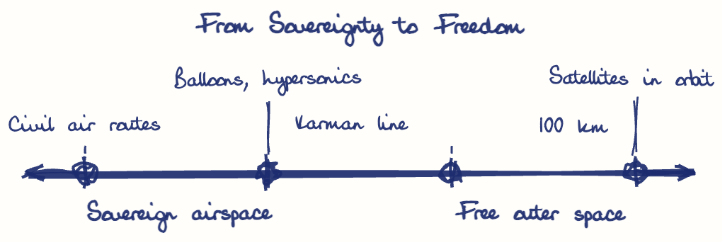
Airspace is the air column above a state's land and 12 nautical mile territorial sea, where foreign aircraft fly only on the state's terms.
Free space above
The Outer Space Treaty (1967) bars national appropriation, so foreign satellites may lawfully overfly and image India.
No agreed boundary
The Karman line of about 100 km is only a convention, so the band between aircraft and satellites stays legally contested.
Legal surveillance
Adversaries can image Indian military sites from orbit without breaking any law.
Grey-zone intrusions
High-altitude balloons, like the Chinese balloon downed over the United States in 2023, and hypersonic vehicles exploit the undefined band.
Space weapons
China's 2007 and India's 2019 Mission Shakti anti-satellite tests show orbits can become battlefields.
Response
The Defence Space Agency (2019), space situational awareness, the IAF's integrated air defence network, anti-drone systems after the Jammu Air Force Station attack (2021), and Indian advocacy at the UN for preventing an arms race in outer space must work together.
This model answer is indicative and the model can make mistakes; please verify key facts independently.
Practise this question
1Get the answer sheet
Sized for this question.
2Write your answer
Timed, by hand.
3Get it marked
Your score and what to fix.
This chapter in the exam
Border Areas12 questions
Asked in 9 of 14 sittings since 2013
- 2026Ladakh is strategically located between China and Pakistan. As a measure to win hearts and minds of locals, discuss the Border Area Development Programmes (BADP) by the Central Government and civic actions by the Army. Also discuss demand of promulgation of provision of the Sixth Schedule of constitution for Ladakh. (Answer in 150 words)
- 2025Why is maritime security vital to protect India's sea trade? Discuss maritime and coastal security challenges and the way forward.
All 12 questions, sorted by sub-topic, with model answers and practice.
Question from the official UPSC Civil Services (Main) Examination 2014 paper. Answer written by Ghissu's engine and checked against our editorial standards. Found an error? Tell us and we correct it within 48 hours.