2014 · GS Paper 3 · Q5 · 12 marks
The Right to Fair Compensation and Transparency in Land Acquisition, Rehabilitation and Resettlement Act, 2013 has come into effect from 1st January, 2014. What are the key issues which would get addressed with the Act in place? What implications would it have on industrialization and agriculture in India?
In short
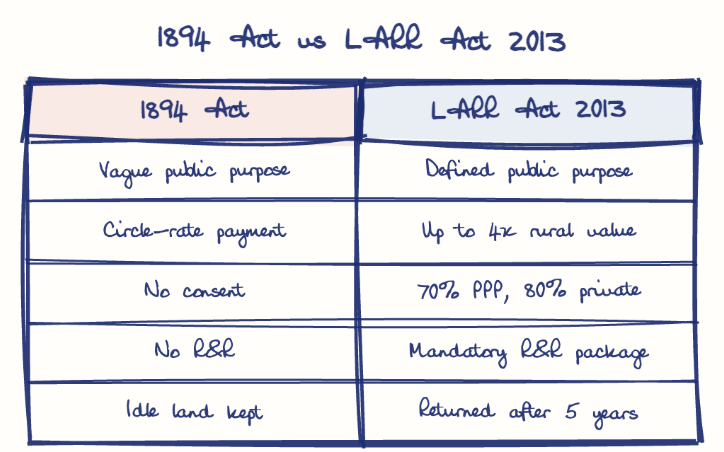
The LARR Act, 2013 tackles undervalued compensation, coercive acquisition, ignored livelihood losers and idle land banking, while raising industry's land costs and shielding farmland. Its core fix is market-linked compensation of up to four times rural value with 70-80% consent and mandatory rehabilitation.
Model answer
Ghissu Editorial · Verified 4 Oct 2026 · 309 words
Undervalued compensation
Circle-rate awards built on understated sale deeds ignored real prices; a rural multiplier of up to two plus 100% solatium now ties payment to market value.
Coercion and silence
A mandatory Social Impact Assessment and Gram Sabha consent in Fifth Schedule areas give affected families a voice.
Invisible livelihood losers
Walter Fernandes estimated about 60 million people displaced after 1947; tenants and labourers now get a house, a job or annuity.
Land banking
Land unused for five years reverts, and 40% of any resale windfall is shared with original owners.
Costlier industrial land
Consent and SIA lengthen timelines, prompting the lapsed 2014 ordinance and state amendments in Gujarat, Maharashtra and Telangana.
Fewer stalled projects
Fair terms cut unrest; the Supreme Court quashed the Singur acquisition in 2016 after Tata moved to Sanand.
Food-security safeguard
Section 10 allows acquiring irrigated multi-cropped land only as a last resort, with equivalent wasteland developed.
Mixed farm gains
Compensation gives capital to diversify, but unrecorded sharecroppers often miss R&R.
This model answer is indicative and the model can make mistakes; please verify key facts independently.
Practise this question
1Get the answer sheet
Sized for this question.
2Write your answer
Timed, by hand.
3Get it marked
Your score and what to fix.
This chapter in the exam
Land Reforms in India7 questions
Asked in 7 of 14 sittings since 2013
- 2024What were the factors responsible for the successful implementation of land reforms in some parts of the country? Elaborate.
- 2023State the objectives and measures of land reforms in India. Discuss how land ceiling policy on landholding can be considered as an effective reform under economic criteria.
All 7 questions, sorted by sub-topic, with model answers and practice.
Question from the official UPSC Civil Services (Main) Examination 2014 paper. Answer written by Ghissu's engine and checked against our editorial standards. Found an error? Tell us and we correct it within 48 hours.