2014 · GS Paper 4 · Q14 · 20 marks
In our country, the migration of rural people to towns and cities is increasing drastically. This is causing serious problems both in the rural as well as in the urban areas. In fact, things are becoming really unmanageable. Can you analyze this problem in detail and indicate not only the socio-economic but also the emotional and attitudinal factors responsible for this problem? Also, distinctly bring out why— (a) educated rural youth are trying to shift to urban areas; (b) landless poor people are migrating to urban slums; (c) even some farmers are selling off their land and trying to settle in urban areas taking up petty jobs. What feasible steps can you suggest which will be effective in controlling this serious problem of our country?
In short
Rural-urban migration becomes a problem when it is distress-driven, caused by unviable small farms, debt, caste control and an urban aspiration gap. The answer is rural jobs through the Rurban Mission and FPOs, land leasing instead of sale, and dignity for migrants through One Nation One Ration Card.
Model answer
Ghissu Editorial · Verified 4 Oct 2026 · 287 words
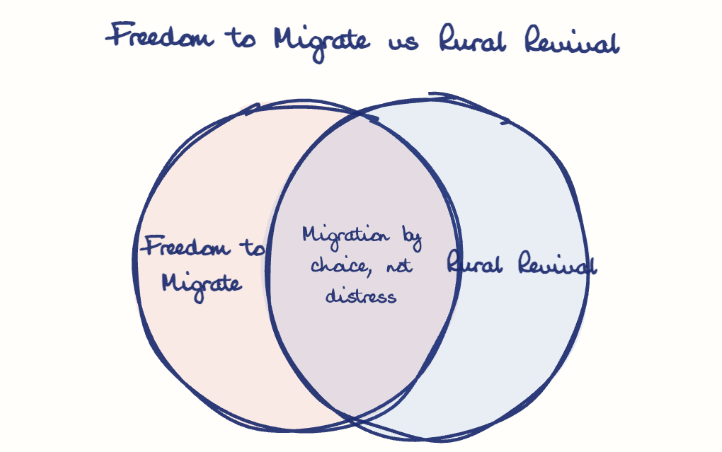
The 2011 Census counted about 45 crore internal migrants. Moving by choice is a freedom under Article 19(1)(e); the problem is distress migration that hollows villages and overloads cities, which held about 6.5 crore slum dwellers in 2011.
Socio-economic, Emotional and Attitudinal Factors
1. Economic push and pull: Tiny holdings (average 1.08 hectare, Agriculture Census 2015-16) and seasonal underemployment push people out; urban wages and services pull them in. 2. Status and escape: Farming is seen as low-status, and the city offers anonymity from caste control and the pride of having "settled" in town.
Skill-job mismatch
Degrees aim at white-collar jobs that villages lack, while cities promise mobility and a modern identity.
No asset, no cushion
Seasonal wage work, debt and caste domination make the city's daily wage the only safety net.
Unviable farming, rising land values
Input costs and climate shocks make farming a gamble, while highway-driven land prices make a one-time sale look safer.
Jobs near villages
Rurban Mission (2016) [scheme] clusters and the 10,000 FPO scheme (2020) [scheme] for agro-processing.
Lease, not sell
NITI Aayog's Model Land Leasing Act (2016) [committee/report] lets farmers earn without losing land.
Dignity in cities
One Nation One Ration Card, e-Shram (2021) and rental housing for migrants.
This model answer is indicative and the model can make mistakes; please verify key facts independently.
Practise this question
1Get the answer sheet
Sized for this question.
2Write your answer
Timed, by hand.
3Get it marked
Your score and what to fix.
This chapter in the exam
Development versus Rights Dilemmas5 questions
Asked in 4 of 14 sittings since 2013
- 2025In line with the Directive Principles of State Policy enshrined in the Indian Constitution, the government has a constitutional obligation to ensure basic needs – "Roti, Kapda aur Makan (Food, Clothes and Shelter)" – for the under-privileged. Pursuing this mandate, the district administration proposed clearing a portion of forest land to develop housing for the homeless and economically weaker sections of the society. The proposed land, however, is an ecologically sensitive zone densely populated with age-old trees, medicinal plants and vital biodiversity. Besides, these forests help to regulate micro-climate and rainfalls; provide habitat for wildlife, support soil fertility and prevent land/soil erosion and sustain livelihoods of tribal and nomadic communities. Inspite of the ecological and social costs, the administration argues in favour of the said proposal by highlighting that this very initiative addresses fundamental human rights as a critical welfare priority. Besides, it fulfils the government's duty to uplift and empower the poor through inclusive housing development. Further, these forest areas have become unsafe due to wild-animal threats and recurring human-wild life conflicts. Lastly, clearing forest-zones may help to curb anti-social elements allegedly using these areas as hideouts, thereby enhancing law and order. (a) Can deforestation be ethically justified in the pursuit of social welfare objectives like, housing for the homeless? (b) What are the socio-economic, administrative and ethical challenges in balancing environmental conservation with human development? (c) What substantial alternatives or policy interventions can be proposed to ensure that both environmental integrity and human dignity are protected?
- 2018A big corporate house is engaged in manufacturing industrial chemicals on a large scale. It proposes to set up an additional unit. Many States rejected its proposal due to detrimental effect on the environment. But one State government acceded to the request and permitted the unit close to a city, brushing aside all opposition. The unit was set up 10 years ago and was in full swing till recently. The pollution caused by the industrial effluents was affecting the land, water and crops in the area. It was also causing serious health problems to human beings and animals. This gave rise to a series of agitations demanding the closure of the plant. In a recent agitation thousands of people took part, creating a law and order problem necessitating stern police action. Following the public outcry, the State government ordered the closure of the factory. The closure of the factory resulted in the unemployment of not only those workers who were engaged in the factory but also those who were working in the ancillary units. It also very badly affected those industries which depended on the chemicals manufactured by it. As a senior officer entrusted with the responsibility of handling this issue, how are you going to address it?
All 5 questions, sorted by sub-topic, with model answers and practice.
Question from the official UPSC Civil Services (Main) Examination 2014 paper. Answer written by Ghissu's engine and checked against our editorial standards. Found an error? Tell us and we correct it within 48 hours.