2018 · GS Paper 4 · Q10 · 20 marks
A big corporate house is engaged in manufacturing industrial chemicals on a large scale. It proposes to set up an additional unit. Many States rejected its proposal due to detrimental effect on the environment. But one State government acceded to the request and permitted the unit close to a city, brushing aside all opposition. The unit was set up 10 years ago and was in full swing till recently. The pollution caused by the industrial effluents was affecting the land, water and crops in the area. It was also causing serious health problems to human beings and animals. This gave rise to a series of agitations demanding the closure of the plant. In a recent agitation thousands of people took part, creating a law and order problem necessitating stern police action. Following the public outcry, the State government ordered the closure of the factory. The closure of the factory resulted in the unemployment of not only those workers who were engaged in the factory but also those who were working in the ancillary units. It also very badly affected those industries which depended on the chemicals manufactured by it. As a senior officer entrusted with the responsibility of handling this issue, how are you going to address it?
In short
I would first secure residents' health and workers' compensation, then make the company pay for remediation and allow reopening only on strict zero-discharge terms, followed by reskilling and accountable approvals. The polluter pays principle applied in Indian Council for Enviro-Legal Action (1996) anchors this course.
Model answer
Ghissu Editorial · Verified 4 Oct 2026 · 289 words
Residents
Damaged land, water, crops and health need remediation, not just closure.
Workers and ancillaries
Lost incomes risk a fresh round of unrest.
Company and State
The Polluter Pays Principle of Vellore Citizens' Welfare Forum (1996) binds the company, while the State's approval despite opposition shows Moral Myopia.
Health first
Medical camps, safe water and Pollution Control Board testing of soil and crops.
Dialogue
A joint forum of residents, workers and management, and an inquiry into the police action.
Worker relief
Closure compensation and unpaid wages under the Industrial Relations Code, 2020.
Polluter pays
Recover remediation costs, as in Indian Council for Enviro-Legal Action (1996) [case].
Conditional reopening
Restart only with zero liquid discharge and online monitoring, or stay shut, as the Supreme Court upheld for Sterlite, Thoothukudi in 2024 [current event].
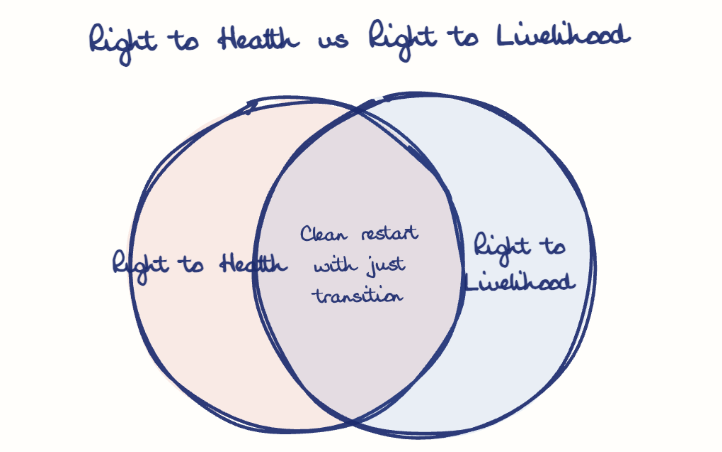
Just transition
Reskill workers and help ancillary MSMEs diversify.
Accountable approvals
Honour EIA public hearings and fix responsibility for the original clearance, per the 2nd ARC [committee/report].
This model answer is indicative and the model can make mistakes; please verify key facts independently.
Practise this question
1Get the answer sheet
Sized for this question.
2Write your answer
Timed, by hand.
3Get it marked
Your score and what to fix.
This chapter in the exam
Development versus Rights Dilemmas5 questions
Asked in 4 of 14 sittings since 2013
- 2025In line with the Directive Principles of State Policy enshrined in the Indian Constitution, the government has a constitutional obligation to ensure basic needs – "Roti, Kapda aur Makan (Food, Clothes and Shelter)" – for the under-privileged. Pursuing this mandate, the district administration proposed clearing a portion of forest land to develop housing for the homeless and economically weaker sections of the society. The proposed land, however, is an ecologically sensitive zone densely populated with age-old trees, medicinal plants and vital biodiversity. Besides, these forests help to regulate micro-climate and rainfalls; provide habitat for wildlife, support soil fertility and prevent land/soil erosion and sustain livelihoods of tribal and nomadic communities. Inspite of the ecological and social costs, the administration argues in favour of the said proposal by highlighting that this very initiative addresses fundamental human rights as a critical welfare priority. Besides, it fulfils the government's duty to uplift and empower the poor through inclusive housing development. Further, these forest areas have become unsafe due to wild-animal threats and recurring human-wild life conflicts. Lastly, clearing forest-zones may help to curb anti-social elements allegedly using these areas as hideouts, thereby enhancing law and order. (a) Can deforestation be ethically justified in the pursuit of social welfare objectives like, housing for the homeless? (b) What are the socio-economic, administrative and ethical challenges in balancing environmental conservation with human development? (c) What substantial alternatives or policy interventions can be proposed to ensure that both environmental integrity and human dignity are protected?
- 2016ABC Ltd. is a large transnational company having diversified business activities with a huge shareholder base. The company is continuously expanding and generating employment. The company, in its expansion and diversification programme, decides to establish a new plant at Vikaspuri, an area which is underdeveloped. The new plant is designed to use energy efficient technology that will help the company to save production cost by 20%. The company's decision goes well with the Government policy of attracting investment to develop such underdeveloped regions. The Government has also announced tax holiday for five years for the companies that invest in underdeveloped areas. However, the new plant may bring chaos for the inhabitants of Vikaspuri region, which is otherwise tranquil. The new plant may result in increased cost of living, aliens migrating to the region, disturbing the social and economic order. The company sensing the possible protest tried to educate the people of Vikaspuri region and public in general that how its Corporate Social Responsibility (CSR) policy would help overcome the likely difficulties of the residents of Vikaspuri region. In spite of this the protests begin and some of the residents decided to approach the judiciary as their plea before the Government did not yield any result. (a) Identify the issues involved in the case. (b) What can be suggested to satisfy the company's goal and to address the residents' concerns?
All 5 questions, sorted by sub-topic, with model answers and practice.
Question from the official UPSC Civil Services (Main) Examination 2018 paper. Answer written by Ghissu's engine and checked against our editorial standards. Found an error? Tell us and we correct it within 48 hours.