2014 · GS Paper 4 · Q3(a) · 10 marks
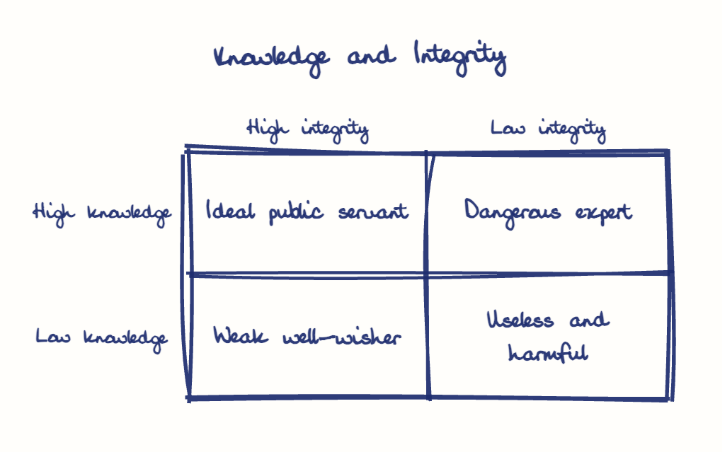
"Integrity without knowledge is weak and useless, but knowledge without integrity is dangerous and dreadful." What do you understand by this statement? Explain your stand with illustrations from the modern context.
In short
Integrity without knowledge cannot turn good intentions into results, while knowledge without integrity turns expertise into a weapon whose harm grows with skill, so both are essential. The Satyam fraud of 2009, about Rs 7,000 crore of inflated accounts, shows how dreadful knowledge without integrity can be.
Model answer
Ghissu Editorial · Verified 4 Oct 2026 · 279 words
Weak and useless
An honest officer who does not grasp the law, data or technology cannot turn good intentions into results, so files stall and schemes fail despite clean hands.
Dangerous and dreadful
Expertise gives power over people who cannot check it; in dishonest hands it enables fraud and manipulation, and the damage grows with the expertise.
Both together
E. Sreedharan's Delhi Metro, whose first phase finished ahead of schedule, joined engineering mastery with refusal to bend procurement rules.
Knowledge misused
Ramalinga Raju's 2009 confession revealed about Rs 7,000 crore of inflated Satyam accounts, and Cambridge Analytica (2018) used data science to target voters.
Integrity needs capacity
Mission Karmayogi (2020) shifts training from rule-based to role-based competence, so honest officers also gain domain skills.
The asymmetry
I agree with the statement, adding that knowledge is easier to teach to a person of integrity than integrity to a person of knowledge.
This model answer is indicative and the model can make mistakes; please verify key facts independently.
Practise this question
1Get the answer sheet
Sized for this question.
2Write your answer
Timed, by hand.
3Get it marked
Your score and what to fix.
This chapter in the exam
Integrity5 questions
Asked in 5 of 14 sittings since 2013
- 2021"Integrity is a value that empowers the human being." Justify with suitable illustration.
- 2018State the three basic values, universal in nature, in the context of civil services and bring out their importance.
All 5 questions, sorted by sub-topic, with model answers and practice.
Question from the official UPSC Civil Services (Main) Examination 2014 paper. Answer written by Ghissu's engine and checked against our editorial standards. Found an error? Tell us and we correct it within 48 hours.