2015 · GS Paper 1 · Q17 · 12 marks
The states of Jammu and Kashmir, Himachal Pradesh and Uttarakhand are reaching the limits of their ecological carrying capacity due to tourism. Critically evaluate.
In short
Tourism has pushed hotspots in Jammu and Kashmir, Himachal Pradesh and Uttarakhand past their ecological carrying capacity, though not the three states as a whole. Joshimath's 2023 subsidence and Shimla's 2018 water crisis show the strain of unregulated, seasonal mass tourism.
Model answer
Ghissu Editorial · Verified 4 Oct 2026 · 268 words
Unsafe construction
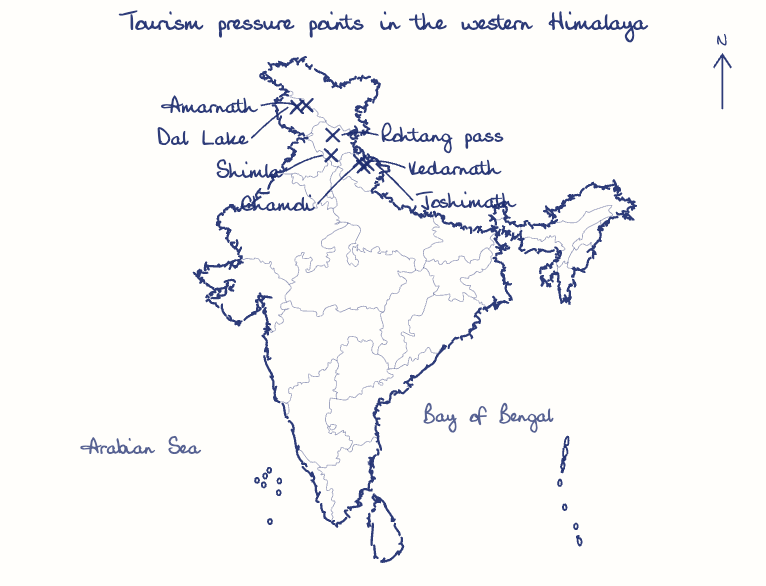
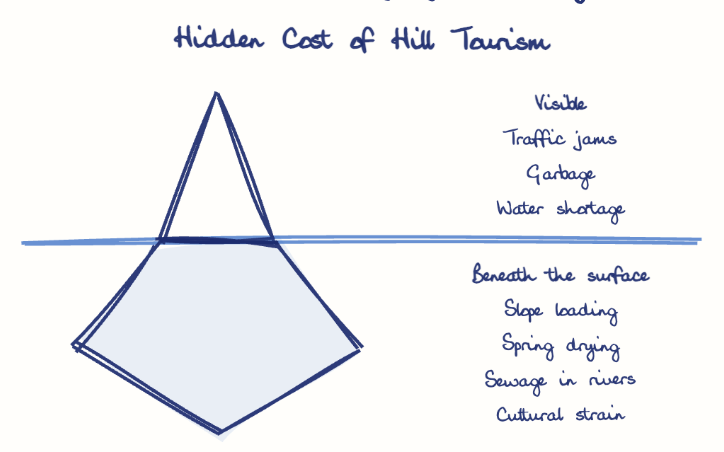
Hotels and roads on unstable slopes raise disaster risk, as Joshimath's subsidence and Shimla's Summer Hill landslide, both in 2023, showed.
Water and waste
Shimla's 2018 water crisis made residents ask tourists to stay away, and peak-season waste swamps Manali and Mussoorie.
Vehicle overload
The NGT capped vehicles to Rohtang Pass, while the Atal Tunnel (2020) pushed traffic into Lahaul.
Lake and pilgrim pressure
Encroachment and sewage have eutrophied Dal Lake, and yatras crowd high-altitude routes.
Localised overload
Strain is concentrated in hotspots and peak seasons, while large tracts remain under-visited.
Other drivers
Hydropower, road widening and climate change, seen in the 2021 Chamoli flood, also stress the slopes.
Economic lifeline
Homestays, taxis, pony operators and guides make tourism a mainstay of hill livelihoods, so curbs must protect incomes.
Manageable models
Sikkim's eco-tourism rules and Bhutan's high-value, low-volume policy show capacity can be managed.
This model answer is indicative and the model can make mistakes; please verify key facts independently.
Practise this question
1Get the answer sheet
Sized for this question.
2Write your answer
Timed, by hand.
3Get it marked
Your score and what to fix.
This chapter in the exam
International Trade / Transport and Activities12 questions
Asked in 9 of 14 sittings since 2013
- 2026"The centre of global trade is gradually shifting from the Atlantic region to the Indo-Pacific region." Examine this statement.
- 2022Mention the significance of straits and isthmus in international trade.
All 12 questions, sorted by sub-topic, with model answers and practice.
Question from the official UPSC Civil Services (Main) Examination 2015 paper. Answer written by Ghissu's engine and checked against our editorial standards. Found an error? Tell us and we correct it within 48 hours.