2015 · GS Paper 2 · Q18 · 12 marks
Discuss the impediments India is facing in its pursuit of a permanent seat in UN Security Council.
In short
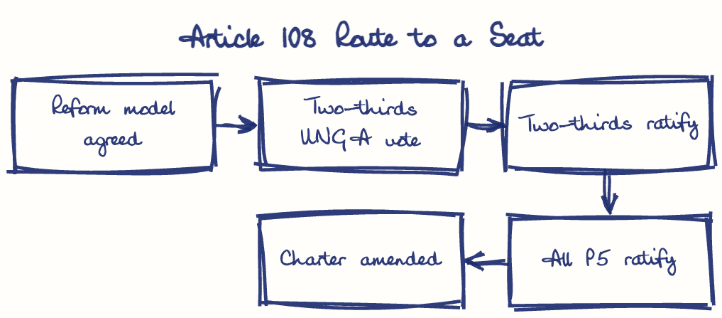
India's pursuit of a permanent UN Security Council seat is blocked by the Charter's amendment rule, text-less negotiations, the veto question and rival coalitions. Article 108 needs ratification by all five permanent members, and China has never endorsed India's bid.
Model answer
Ghissu Editorial · Verified 4 Oct 2026 · 275 words
P5 lock
Article 108 requires a two-thirds Assembly vote and ratification by two-thirds of members including all five permanent members, so one refusal kills expansion; the only enlargement, in 1965, added non-permanent seats alone.
Text-less talks
The Intergovernmental Negotiations, running since 2009 by consensus without an agreed draft, let opponents stall indefinitely.
Veto and Africa
The P5 resist sharing the veto, and the Ezulwini Consensus (2005) demands two African permanent seats with veto, so the 54-member African Group does not back the G4 model.
China's resistance
China, the only Asian permanent member, has never endorsed India's bid and opposes the G4 package that would also seat its rival Japan.
Uniting for Consensus
Italy, Pakistan, Argentina, Mexico and South Korea oppose any new permanent seat, giving each G4 aspirant a regional rival.
Credentials and lukewarm backing
Opponents cite India's stand outside the NPT and small UN budget share, while US, UK, French and Russian endorsements stay rhetorical.
This model answer is indicative and the model can make mistakes; please verify key facts independently.
Practise this question
1Get the answer sheet
Sized for this question.
2Write your answer
Timed, by hand.
3Get it marked
Your score and what to fix.
This chapter in the exam
Institutions12 questions
Asked in 10 of 14 sittings since 2013
- 2025"The reform process in the United Nations remains unresolved, because of the delicate imbalance of East and West and entanglement of the USA vs. Russo-Chinese alliance." Examine and critically evaluate the East-West policy confrontations in this regard.
- 2024Terrorism has become a significant threat to global peace and security.' Evaluate the effectiveness of the United Nations Security Council's Counter Terrorism Committee (CTC) and its associated bodies in addressing and mitigating this threat at the international level.
All 12 questions, sorted by sub-topic, with model answers and practice.
Question from the official UPSC Civil Services (Main) Examination 2015 paper. Answer written by Ghissu's engine and checked against our editorial standards. Found an error? Tell us and we correct it within 48 hours.