2015 · GS Paper 2 · Q8 · 12 marks
Examine critically the recent changes in the rules governing foreign funding of NGOs under the Foreign Contribution (Regulation) Act (FCRA), 1976.
In short
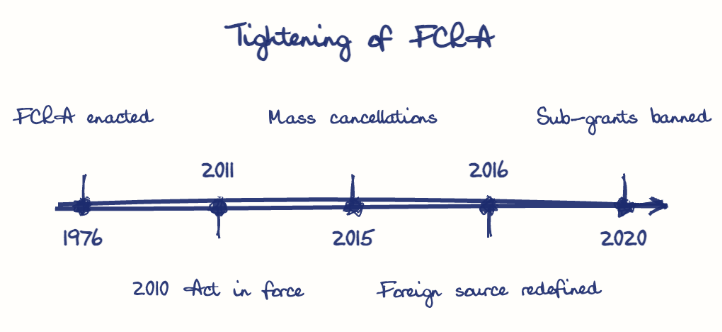
The FCRA 2010 and its 2011 Rules replaced the 1976 law with five-year registration, a bar on political organisations and spending caps, but vague grounds and selective enforcement turned regulation into control. In 2015 about 9,000 NGOs lost registration and Greenpeace India's licence was cancelled.
Model answer
Ghissu Editorial · Verified 4 Oct 2026 · 279 words
Renewable registration
Registration, once permanent, now lapses every five years, so an NGO's record is reviewed before renewal.
Political bar
Organisations "of a political nature", identified under Rule 9 by markers such as bandhs and rasta roko, cannot take foreign money.
Spending discipline
Administrative spending was capped at 50%, speculative investment barred and a designated bank account made funds traceable.
Stricter enforcement
About 9,000 NGOs lost registration in 2015 for not filing returns, and online filing and quarterly disclosure became mandatory.
Vague grounds
Terms like "public interest" give officials wide discretion, as Greenpeace India's cancellation in 2015 after its anti-coal campaigns showed.
Double standard
A 2014 Intelligence Bureau report branded foreign-funded NGOs anti-development, yet the Finance Act 2016 retrospectively redefined "foreign source" to shield political parties' donations.
Weak due process
Suspension for 180 days and frozen accounts precede any finding, and the 2020 ban on sub-grants, upheld in Noel Harper (2022), hit small groups hardest.
This model answer is indicative and the model can make mistakes; please verify key facts independently.
Practise this question
1Get the answer sheet
Sized for this question.
2Write your answer
Timed, by hand.
3Get it marked
Your score and what to fix.
This chapter in the exam
NGOs5 questions
Asked in 4 of 14 sittings since 2013
- 2023Discuss the contribution of civil society groups for women's effective and meaningful participation and representation in state legislatures in India.
- 2021Can Civil Society and Non-Governmental Organizations present an alternative model of public service delivery to benefit the common citizen? Discuss the challenges of this alternative model.
All 5 questions, sorted by sub-topic, with model answers and practice.
Question from the official UPSC Civil Services (Main) Examination 2015 paper. Answer written by Ghissu's engine and checked against our editorial standards. Found an error? Tell us and we correct it within 48 hours.