2023 · GS Paper 2 · Q14 · 15 marks
Discuss the contribution of civil society groups for women's effective and meaningful participation and representation in state legislatures in India.
In short
Civil society groups have advanced women's participation and representation in state legislatures through agenda-setting, grassroots collectives, voter mobilisation, training and watchdog data. Their decades of campaigning helped produce the 106th Amendment Act 2023, which reserves one-third of assembly seats for women.
Model answer
Ghissu Editorial · Verified 4 Oct 2026 · 288 words
Agenda-setting
The Towards Equality report (1974) exposed women's political exclusion, the National Perspective Plan (1988) sought local-body quotas, and AIDWA and NFIW campaigned for decades on the Women's Reservation Bill.
Grassroots collectives
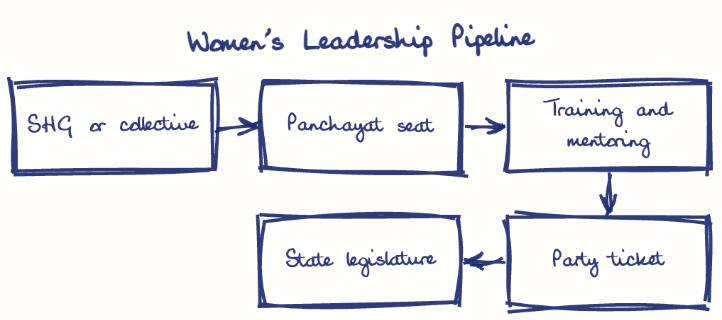
Kudumbashree and SEWA give women experience of budgets and public speaking that leads to local candidacy.
Voter mobilisation
Civil society partners of SVEEP helped women's turnout overtake men's in 2019.
Capacity building
The Hunger Project and PRIA train elected women panchayat members against proxy rule, building a pipeline to assemblies.
Watchdog data
ADR found women were under 10 per cent of Lok Sabha candidates in 2024, evidence against party gatekeeping.
Breaking barriers
Sustained advocacy preceded Nagaland electing its first two women MLAs in 2023.
Timely implementation
Monitor the census and delimitation that trigger the 106th Amendment.
Party ticket quotas
Press parties to follow the BJD's 2019 example of fielding women in a third of its seats.
Campaign support
Push for state funding of elections and swift action against online abuse of women candidates.
This model answer is indicative and the model can make mistakes; please verify key facts independently.
Practise this question
1Get the answer sheet
Sized for this question.
2Write your answer
Timed, by hand.
3Get it marked
Your score and what to fix.
This chapter in the exam
NGOs5 questions
Asked in 4 of 14 sittings since 2013
- 2021Can Civil Society and Non-Governmental Organizations present an alternative model of public service delivery to benefit the common citizen? Discuss the challenges of this alternative model.
- 2016"In the Indian governance system, the role of non-state actors has been only marginal." Critically examine this statement.
All 5 questions, sorted by sub-topic, with model answers and practice.
Question from the official UPSC Civil Services (Main) Examination 2023 paper. Answer written by Ghissu's engine and checked against our editorial standards. Found an error? Tell us and we correct it within 48 hours.