2015 · GS Paper 2 · Q15 · 12 marks
If amendment bill to the Whistleblowers Protection Act 2011 tabled in the Parliament is passed, there may be no one left to protect. Critically Evaluate.
In short
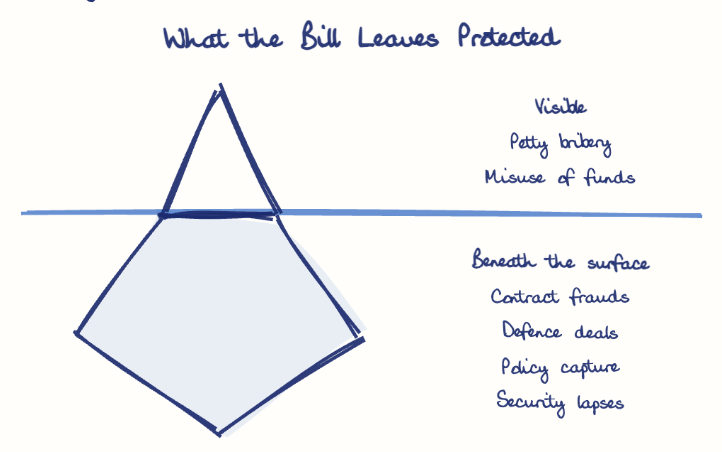
The charge is largely valid: by importing the RTI Act's Section 8(1) exemptions without a public interest override and removing the Official Secrets Act shield, the 2015 Bill would leave the gravest disclosures unprotected. Only petty corruption, such as bribery and misused funds, would stay reportable.
Model answer
Ghissu Editorial · Verified 4 Oct 2026 · 281 words
RTI exemptions imported
The Bill bars disclosures touching security, economic interests, Cabinet papers, commercial confidence and personal data, mirroring Section 8(1) of the RTI Act, unless already obtained under RTI.
Shield removed, gate added
It deletes the Official Secrets Act override and lets a government-chosen authority decide finally whether a disclosure is barred.
Core of corruption excluded
Big-ticket graft lies in contracts and procurement, so even Dubey's complaint would arguably fall within "commercial confidence".
Wrong yardstick
Whistleblowers report in confidence to the CVC, not to the public, yet the Bill omits the public-interest override of Section 8(2) of the RTI Act.
The government's case
The 2014 Act had no filter for security leaks, and bribery or misused funds remain reportable, so "no one" overstates the loss.
Public interest test
A harm versus public interest test by the CVC, as in the UK's Public Interest Disclosure Act, 1998, and secure channels under Article 33 of UNCAC would balance secrecy and exposure.
This model answer is indicative and the model can make mistakes; please verify key facts independently.
Practise this question
1Get the answer sheet
Sized for this question.
2Write your answer
Timed, by hand.
3Get it marked
Your score and what to fix.
This chapter in the exam
Government Interventions — Schemes & Legislation5 questions
Asked in 4 of 14 sittings since 2013
- 2024What are the aims and objects of recently passed and enforced, The Public Examination (Prevention of Unfair Means) Act, 2024? Whether University/State Education Board examinations, too, are covered under the Act?
- 2015What are the major changes brought in the Arbitration and Conciliation Act, 1996 through the recent Ordinance promulgated by the President? How far will it improve India's dispute resolution mechanism? Discuss.
All 5 questions, sorted by sub-topic, with model answers and practice.
Question from the official UPSC Civil Services (Main) Examination 2015 paper. Answer written by Ghissu's engine and checked against our editorial standards. Found an error? Tell us and we correct it within 48 hours.