2015 · GS Paper 3 · Q13 · 12 marks
Discuss the advantages and security implications of cloud hosting of servers vis-a-vis in-house machine-based hosting for government businesses.
In short
Cloud hosting gives government lower cost, elastic capacity, reuse and disaster recovery that in-house servers cannot, but brings risks of misconfiguration, foreign jurisdiction and vendor lock-in. A hybrid, MeitY-audited cloud with government data kept in India balances efficiency and security.
Model answer
Ghissu Editorial · Verified 4 Oct 2026 · 286 words
Lower cost
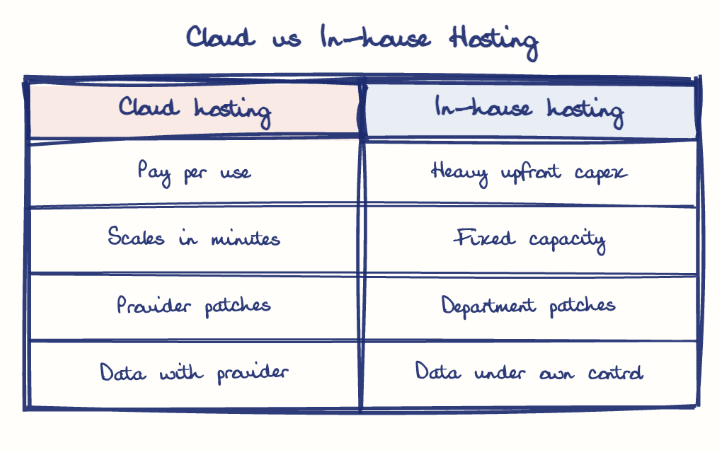
Pay-as-you-use replaces capital spending on servers, cooling, power and specialist staff, which suits small departments and states.
Elasticity
Capacity scales up for spikes such as exam results or tax deadlines and down afterwards, where fixed servers crash or idle.
Reuse and resilience
An application built once can be replicated across states, the app-store model MeghRaj intended, and separate data centres give ready disaster recovery.
Shared responsibility
The department must still configure access correctly; a misconfigured firewall exposed about 100 million Capital One customers in the cloud in 2019.
Sovereignty
A foreign provider's data may fall under laws such as the US CLOUD Act, 2018, so MeitY empanels providers after STQC audits and keeps government data in India.
Lock-in and multi-tenancy
Shared hardware risks cross-tenant leaks, and single-vendor dependence makes exit costly.
In-house risk too
The 2022 ransomware attack on AIIMS Delhi's own servers showed that on-premise hosting is only as safe as its staff and patching.
This model answer is indicative and the model can make mistakes; please verify key facts independently.
Practise this question
1Get the answer sheet
Sized for this question.
2Write your answer
Timed, by hand.
3Get it marked
Your score and what to fix.
This chapter in the exam
IT5 questions
Asked in 5 of 14 sittings since 2013
- 2026What is agentic Artificial Intelligence (AI)? Explain its working. Describe its applications with suitable examples. Discuss the advantages, risks and challenges associated with agentic AI systems. (Answer in 250 words)
- 2024What is the technology being employed for electronic toll collection on highways? What are its advantages and limitations? What are the proposed changes that will make this process seamless? Would this transition carry any potential hazards?
All 5 questions, sorted by sub-topic, with model answers and practice.
Question from the official UPSC Civil Services (Main) Examination 2015 paper. Answer written by Ghissu's engine and checked against our editorial standards. Found an error? Tell us and we correct it within 48 hours.