2015 · GS Paper 4 · Q7 · 10 marks
At the international level, the bilateral relations between most nations are governed on the policy of promoting one's own national interest without any regard for the interest of other nations. This leads to conflicts and tensions between the nations. How can ethical consideration help resolve such tensions? Discuss with specific examples.
In short
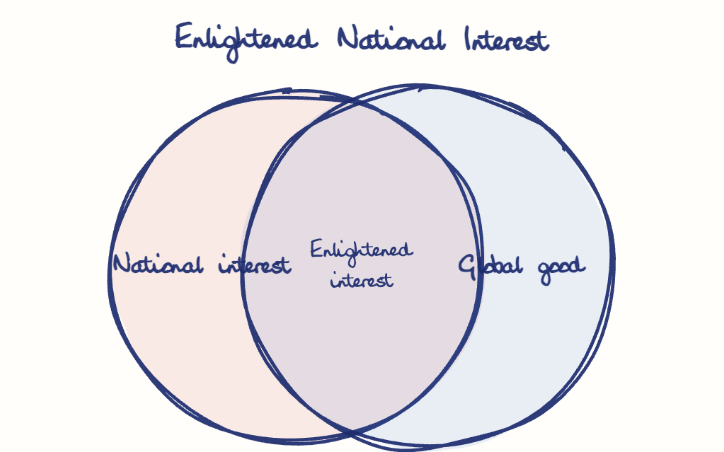
Ethical considerations such as empathy, fairness, restraint and keeping one's word turn zero-sum rivalry into negotiable difference, making ethics the enlightened form of national interest. India's acceptance of the 2014 maritime boundary award favouring Bangladesh, followed by the 2015 Land Boundary Agreement, built lasting goodwill.
Model answer
Ghissu Editorial · Verified 4 Oct 2026 · 264 words
Empathy and respect
The Panchsheel principles of 1954 placed mutual respect for sovereignty and non-interference at the centre of diplomacy.
Justice and fairness
Common But Differentiated Responsibilities in the UNFCCC (1992) made climate cooperation possible between rich and poor nations.
Restraint
Kant's imperative to treat others as ends applies to nations, and India's No First Use doctrine (2003) keeps crises from spiralling.
Keeping one's word
India accepted the 2014 arbitral award on its maritime boundary with Bangladesh though it largely favoured Dhaka, building lasting goodwill.
Generosity over grievance
India launched Operation Dost after the 2023 Turkey earthquake despite Ankara's stance on Kashmir, and Vaccine Maitri (2021) countered Vaccine Nationalism, the hoarding of global goods.
Give and take
The Land Boundary Agreement of 2015 peacefully exchanged enclaves with Bangladesh and settled a dispute of four decades.
Reconciliation
Willy Brandt's kneeling in Warsaw (1970) and South Africa's Truth and Reconciliation Commission showed that acknowledging past wrongs heals enmity.
This model answer is indicative and the model can make mistakes; please verify key facts independently.
Practise this question
1Get the answer sheet
Sized for this question.
2Write your answer
Timed, by hand.
3Get it marked
Your score and what to fix.
This chapter in the exam
Ethical issues in international relations and funding9 questions
Asked in 9 of 14 sittings since 2013
- 2026In international relations, ethical considerations are often subjugated to the strategic interests of nation-states. Discuss this from an ethical perspective.
- 2025Carl von Clausewitz once said, "War is a diplomacy by other means." Critically analyse the above statement in the present context of contemporary geo-political conflict.
All 9 questions, sorted by sub-topic, with model answers and practice.
Question from the official UPSC Civil Services (Main) Examination 2015 paper. Answer written by Ghissu's engine and checked against our editorial standards. Found an error? Tell us and we correct it within 48 hours.