2015 · GS Paper 4 · Q8 · 10 marks
Public servants are likely to confront with the issues of 'Conflict of Interest'. What do you understand by the term 'Conflict of Interest' and how does it manifest in the decision making by public servants? If faced with the conflict of interest situation, how would you resolve it? Explain with the help of examples.
In short
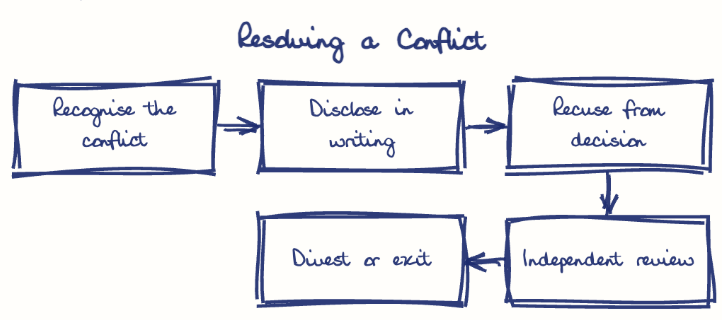
A conflict of interest arises when a public servant's private interest could sway impartial duty, showing up in tenders, recruitment, regulation and gifts, and it is resolved by recognising, disclosing, recusing and, if needed, divesting. Justice U.U. Lalit's withdrawal from the Ayodhya bench in January 2019 shows recusal in practice.
Model answer
Ghissu Editorial · Verified 4 Oct 2026 · 291 words
Contracts
An officer evaluating a tender in which a relative's firm bids may tilt the scoring, which is why Rule 4(3) of the CCS (Conduct) Rules, 1964 makes him refer such a matter to his superior.
Recruitment
A board member whose relative appears for interview may mark generously, so recruiting bodies require declaration and withdrawal.
Regulatory capture
A regulator hoping for a post-retirement job in the industry it oversees may soften inspections and quietly serve those it was meant to check.
Applying it to a tender
If my brother-in-law's firm bid for a road contract I was to sanction, I would record the relationship on file, hand the evaluation to a committee under another officer, and stay out of every later stage.
Judicial benchmark
Justice U.U. Lalit withdrew from the Ayodhya bench in January 2019 because he had once appeared as counsel in a connected case.
Continuing interests
Shares in a company I regulate call for divestment or a transfer, since disclosure alone cannot remove a lasting interest.
This model answer is indicative and the model can make mistakes; please verify key facts independently.
Practise this question
1Get the answer sheet
Sized for this question.
2Write your answer
Timed, by hand.
3Get it marked
Your score and what to fix.
This chapter in the exam
Ethical concerns and dilemmas in government and private institutions13 questions
Asked in 7 of 14 sittings since 2013
- 2026Owing to paucity of time, a university professor generates a Ph.D. evaluation report using Artificial Intelligence and submits it with some modifications. Discuss this from the perspective of accountability and integrity.
- 2026A business house is working on a project that could displace a forest community from their habitat. As the administrative officer of that district, what ethical challenges are you likely to face?
All 13 questions, sorted by sub-topic, with model answers and practice.
Question from the official UPSC Civil Services (Main) Examination 2015 paper. Answer written by Ghissu's engine and checked against our editorial standards. Found an error? Tell us and we correct it within 48 hours.