2026 · GS Paper 4 · Q1(b) · 10 marks
A business house is working on a project that could displace a forest community from their habitat. As the administrative officer of that district, what ethical challenges are you likely to face?
In short
The officer faces clashes between development and livelihood, genuine and manufactured consent, cultural loss and cash compensation, and pressure from political and corporate interests against impartiality. The Forest Rights Act, 2006 and the Niyamgiri judgment (2013) make the Gram Sabha's free consent the ethical and legal test.
Model answer
Ghissu Editorial · Verified 4 Oct 2026 · 281 words
Development vs livelihood
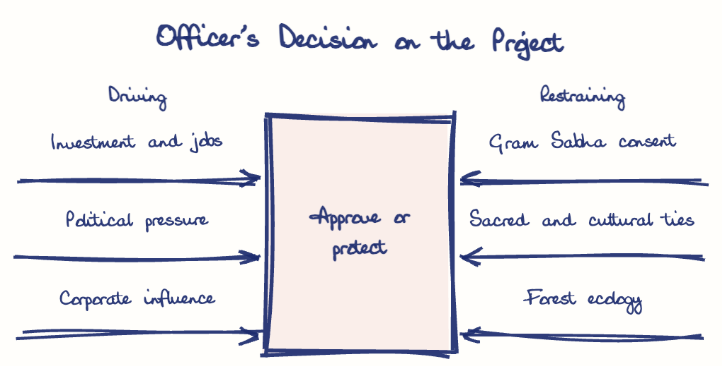
Investment and jobs come at the cost of forests that feed the community, and intergenerational equity demands that the ecological loss to future generations be counted.
Genuine vs manufactured consent
The Forest Rights Act, 2006 empowers the Gram Sabha to protect forest rights, and in Niyamgiri (2013) the Dongria Kondh Gram Sabhas rejected bauxite mining, so the officer must resist staged resolutions.
Culture beyond compensation
Sacred groves and burial grounds have no market price, so cash cannot restore what displacement destroys.
Rehabilitation that restores
The 2013 Land Acquisition Act requires a Social Impact Assessment and 80% consent of affected families for private projects.
Pressure vs impartiality
Yielding to political or corporate pressure for fear of transfer is conscience laundering through hierarchy.
Conflict of interest
Gifts or CSR favours can bias judgment, against the Nolan Principle of integrity.
Compassion vs neutrality
Empathy for an unheard community must not become hostility to lawful investment, since the officer serves the whole district.
This model answer is indicative and the model can make mistakes; please verify key facts independently.
Practise this question
1Get the answer sheet
Sized for this question.
2Write your answer
Timed, by hand.
3Get it marked
Your score and what to fix.
This chapter in the exam
Ethical concerns and dilemmas in government and private institutions13 questions
Asked in 7 of 14 sittings since 2013
- 2026Owing to paucity of time, a university professor generates a Ph.D. evaluation report using Artificial Intelligence and submits it with some modifications. Discuss this from the perspective of accountability and integrity.
- 2026An endangered tribe has developed a severe skeletal deformity. A university research has identified a mineral supplement as a possible remedy, though clinical trials are yet to be conducted. Should the District Magistrate (DM) use this research on the tribe? Discuss from the perspective of medical and administrative ethics.
All 13 questions, sorted by sub-topic, with model answers and practice.
Question from the official UPSC Civil Services (Main) Examination 2026 paper. Answer written by Ghissu's engine and checked against our editorial standards. Found an error? Tell us and we correct it within 48 hours.