2016 · GS Paper 1 · Q3 · 12 marks
Explain how the Uprising of 1857 constitutes an important watershed in the evolution of British policies towards colonial India.
In short
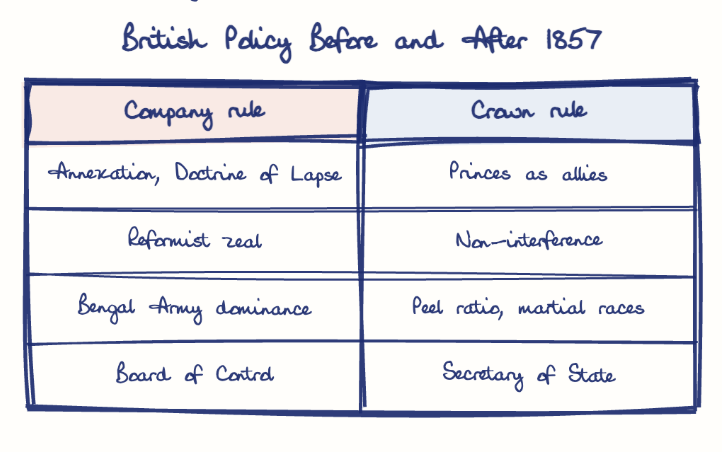
The 1857 uprising was a watershed because British policy shifted from conquest and reform to consolidation through Crown rule, loyal princes and landlords, a reorganised army and divide and rule. The Government of India Act 1858 ended Company rule and created a Secretary of State for India.
Model answer
Ghissu Editorial · Verified 4 Oct 2026 · 289 words
Transfer to the Crown
The Government of India Act 1858 ended Company rule and created a Secretary of State with a Council of India, while Queen Victoria's Proclamation promised religious tolerance.
Princes and landlords
The Doctrine of Lapse was dropped and adoption recognised, as Canning saw princes as breakwaters, and Awadh's taluqdars regained their estates.
Token association
The Indian Councils Act 1861 let the Viceroy nominate Indians to the legislature without real power.
Reorganised army
The Peel Commission (1859) fixed a 1:2 European to Indian ratio in Bengal, kept artillery British, and recruitment shifted to Punjab and the Gorkhas, later branded martial races.
Non-interference and division
Bentinck-era social reform gave way to non-interference in religion, and Muslims, first blamed for the revolt, were later courted as W.W. Hunter urged in 1871.
Continuity of exploitation
Annexation ended, but the drain through Home Charges and one-way free trade deepened.
This model answer is indicative and the model can make mistakes; please verify key facts independently.
Practise this question
1Get the answer sheet
Sized for this question.
2Write your answer
Timed, by hand.
3Get it marked
Your score and what to fix.
This chapter in the exam
Revolt of 18572 questions
Asked in 2 of 14 sittings since 2013
Question from the official UPSC Civil Services (Main) Examination 2016 paper. Answer written by Ghissu's engine and checked against our editorial standards. Found an error? Tell us and we correct it within 48 hours.