2019 · GS Paper 1 · Q2 · 10 marks
The 1857 Uprising was the culmination of the recurrent big and small local rebellions that had occurred in the preceding hundred years of British rule. Elucidate.
In short
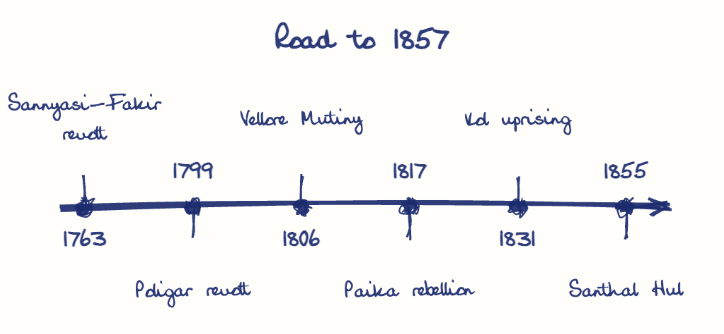
The 1857 Uprising inherited the grievances, actors and religious idiom of a century of local revolts by dispossessed rulers, peasants, tribals and sepoys, but surpassed them in scale and in rallying behind one symbol. Precursors ranged from the Sannyasi-Fakir revolt of 1763 to the Santhal Hul of 1855.
Model answer
Ghissu Editorial · Verified 4 Oct 2026 · 287 words
Dispossessed rulers
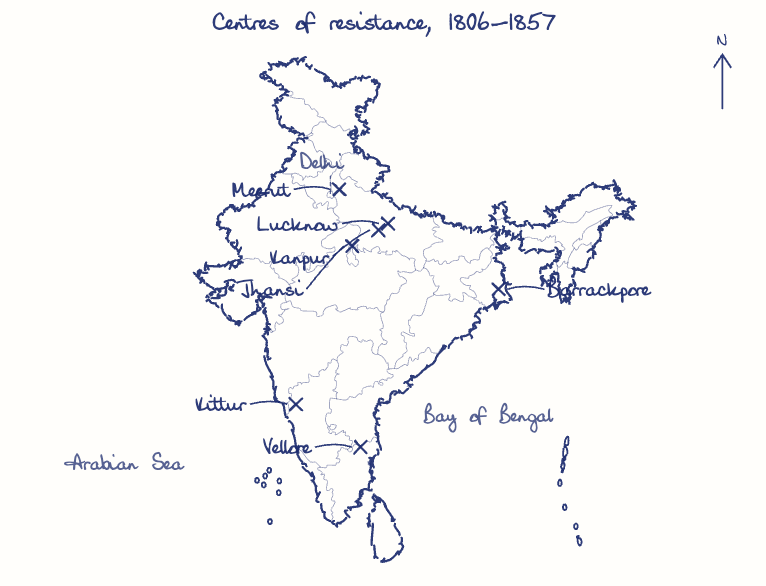
Kattabomman of the Poligars, Velu Thampi of Travancore and Rani Chennamma of Kittur (1824) fought annexation, the grievance that later moved Nana Saheb and Rani Lakshmibai.
Peasants and tribals
The Paika rebellion (1817) against revenue demands and the Kol and Santhal risings over land and forest rehearsed the agrarian fury seen in Awadh.
Sepoy discontent
The Vellore Mutiny (1806) over caste marks and the Barrackpore mutiny (1824) over service in Burma foreshadowed the fears behind the greased cartridges.
Scale and symbol
Sepoys joined zamindars, peasants and artisans from Delhi to Kanpur, Lucknow and Jhansi, and rallied behind Bahadur Shah Zafar.
Not a straight line
The south, home of the Poligar and Kittur revolts, stayed largely quiet in 1857, while Punjab and most princes sided with the British, so continuity was uneven across regions.
Fresh triggers
Awadh's annexation in 1856 and the greased Enfield cartridges supplied new sparks that no earlier revolt had faced.
This model answer is indicative and the model can make mistakes; please verify key facts independently.
Practise this question
1Get the answer sheet
Sized for this question.
2Write your answer
Timed, by hand.
3Get it marked
Your score and what to fix.
This chapter in the exam
Revolt of 18572 questions
Asked in 2 of 14 sittings since 2013
Question from the official UPSC Civil Services (Main) Examination 2019 paper. Answer written by Ghissu's engine and checked against our editorial standards. Found an error? Tell us and we correct it within 48 hours.